
Why Brand Awareness Matters for Business Growth
People are more likely to consider businesses they already know.
When customers repeatedly encounter useful and consistent content from a brand, familiarity can develop. Over time, that familiarity can support trust and consideration.
Strong brand awareness can help businesses:
- Increase visibility
- Build credibility
- Generate more website traffic
- Improve customer consideration
- Support lead generation
- Increase conversions
- Strengthen customer loyalty
- Create a competitive advantage
But there is an important distinction.
Brand awareness does not automatically equal revenue.
You need a strategy that connects awareness with the rest of your marketing funnel.
Brand Awareness vs. Business Growth
Brand awareness focuses on whether people know and remember your business.
Business growth focuses on measurable outcomes such as:
- Leads
- Customers
- Sales
- Revenue
- Customer retention
- Market share
- Profitability
Think of brand awareness as the starting point, not the destination.
For example, imagine a company spends six months creating social media content and reaches one million impressions.
That sounds impressive.
But what happened next?
Did people visit the website?
Did they enquire?
Did they sign up?
Did they purchase?
Did they become repeat customers?
If the answer is no, the business may have generated visibility without generating meaningful growth.
That’s why successful marketing connects attention with action.
How to Turn Brand Awareness Into Business Growth
1. Define Your Target Audience
The first step is knowing exactly who you want to reach.
Trying to make your brand visible to everyone can result in wasted marketing resources and weak messaging.
Instead, define your ideal customer.
Consider:
- Age
- Location
- Industry
- Job role
- Interests
- Problems
- Buying behaviour
- Budget
- Decision-making process
The more clearly you understand your audience, the easier it becomes to create relevant campaigns.
For example, a B2B software company shouldn’t communicate the same way as a fashion brand targeting young consumers.
Your audience should influence your:
- Content
- Tone
- Advertising
- Offers
- Platforms
- Messaging
- Calls to action
When the right people see the right message repeatedly, brand awareness becomes more valuable.
2. Build a Strong and Consistent Brand Message
Consistency helps people understand what your business represents.
Your website may say one thing, your Instagram page another, and your advertisements something completely different. This can create confusion.
Your brand message should communicate:
- Who you are
- What you offer
- Who you help
- What problem you solve
- Why customers should choose you
Keep your core message consistent across your website, social media, advertising, videos, emails, and offline marketing.
Consistency doesn’t mean every piece of content must look identical.
It means your audience should recognize the same brand promise and positioning wherever they encounter you.
3. Create Content That Moves People Beyond Awareness
One of the biggest mistakes businesses make is creating content only for visibility.
Awareness content is important, but customers also need information that helps them make decisions.
Create content for different stages of the customer journey.
Awareness Content
This introduces your brand to new audiences.
Examples include:
- Short-form videos
- Social media posts
- Educational blogs
- Infographics
- Industry insights
Consideration Content
This helps people understand why your solution may be right for them.
Examples include:
- Comparisons
- Case studies
- Product demonstrations
- Expert guides
- Webinars
- Customer stories
Conversion Content
This encourages people to take action.
Examples include:
- Free consultations
- Product demos
- Special offers
- Free trials
- Service pages
- Contact forms
Your content strategy should therefore answer three questions:
Why should people notice us?
Why should they trust us?
Why should they choose us?
4. Build Trust Through Social Proof
Awareness may get attention, but trust often helps turn attention into action.
Customers want evidence that your business can deliver what it promises.
That’s where social proof becomes valuable.
Use:
- Customer reviews
- Testimonials
- Case studies
- Client success stories
- Ratings
- User-generated content
- Before-and-after results
- Industry recognition
For example, instead of simply saying:
“We provide excellent marketing services.”
You can demonstrate the value through a case study showing how a client improved their visibility, generated leads, or achieved another measurable outcome.
The more credible evidence you provide, the easier it becomes for potential customers to move from awareness to consideration.
5. Give Your Audience a Clear Next Step
A person can like your content and still never become a customer.
Why?
Because you didn’t tell them what to do next.
Every major marketing touchpoint should have an appropriate call to action.
Depending on your business, this could be:
- Learn more
- Visit our website
- Download the guide
- Book a consultation
- Request a quote
- Start a free trial
- Contact our team
- Make a purchase
Your CTA should match the customer’s stage.
Someone discovering your brand for the first time may not be ready to buy immediately.
Instead, invite them to learn more.
A warmer prospect might be ready to book a consultation or request pricing.
The objective is to create a smooth path from attention to action.
6. Use Multiple Marketing Channels
Customers rarely follow a perfectly linear journey.
Someone might discover your brand through Instagram, search for you on Google, read your blog, watch a YouTube video, and eventually contact you through your website.
That’s why businesses should think beyond a single marketing channel.
Depending on your audience and goals, your strategy could include:
- SEO
- Social media marketing
- Video marketing
- Paid advertising
- Email marketing
- Content marketing
- Influencer marketing
- Offline advertising
- Events
- Direct marketing
The key isn’t to be everywhere.
The key is to identify the channels where your target customers spend time and create a connected experience across them.
This is where an integrated or 360° marketing strategy can be particularly effective.
7. Retarget People Who Already Know Your Brand
Not everyone will convert the first time they interact with your business.
Someone might visit your website and leave.
Another person might watch your video but not enquire.
Someone else might add a product to their cart without completing the purchase.
These audiences already know your brand, making them valuable prospects for future communication.
Retargeting can help businesses reconnect with people who have previously interacted with their brand.
For example, you could show relevant advertisements to people who:
- Visited your website
- Viewed a product
- Watched a video
- Engaged with social media
- Started but didn’t complete an action
Instead of constantly searching for completely new audiences, you can also continue engaging people who have already shown interest.
8. Create Offers That Encourage Action
Awareness can create interest, but the right offer can help turn interest into action.
Depending on your business model, consider offering:
- Free consultations
- Free trials
- Product demonstrations
- Downloadable guides
- Introductory offers
- Limited-time promotions
- Strategy sessions
- Educational webinars
The offer should solve a real problem or reduce the friction involved in taking the next step.
For example, a potential customer who isn’t ready to purchase a high-value service may be willing to book a free consultation.
That consultation can then become the bridge between brand awareness and a sales conversation.
9. Measure More Than Impressions
One of the most important steps in turning brand awareness into business growth is measuring the right metrics.
Impressions and reach can tell you how many people saw your content.
But they don’t tell the entire story.
Track metrics such as:
Awareness Metrics
- Reach
- Impressions
- Brand searches
- Video views
- Social mentions
Engagement Metrics
- Likes
- Comments
- Shares
- Saves
- Website engagement
- Video completion rate
Conversion Metrics
- Leads
- Enquiries
- Sign-ups
- Purchases
- Conversion rate
Business Metrics
- Customer acquisition cost
- Customer lifetime value
- Revenue
- Return on marketing investment
- Repeat purchase rate
The goal is to connect marketing activity with business outcomes.
Instead of asking only:
“How many people saw our campaign?”
Ask:
“What did those people do after seeing it?”
10. Keep Optimizing Your Strategy
Marketing is not something you build once and leave unchanged.
Customer behaviour changes.
Platforms change.
Competitors change.
Consumer expectations change.
Your marketing strategy should evolve too.
Test different:
- Headlines
- Content formats
- Offers
- Calls to action
- Advertising messages
- Landing pages
- Target audiences
- Marketing channels
Then use performance data to understand what works.
For example, if short-form videos generate significant engagement but don’t generate website visits, consider improving the CTA.
If a blog generates traffic but few leads, review its conversion opportunities.
If an advertisement generates many clicks but few enquiries, examine the landing page and offer.
Continuous optimization helps turn marketing from a collection of activities into a growth engine.
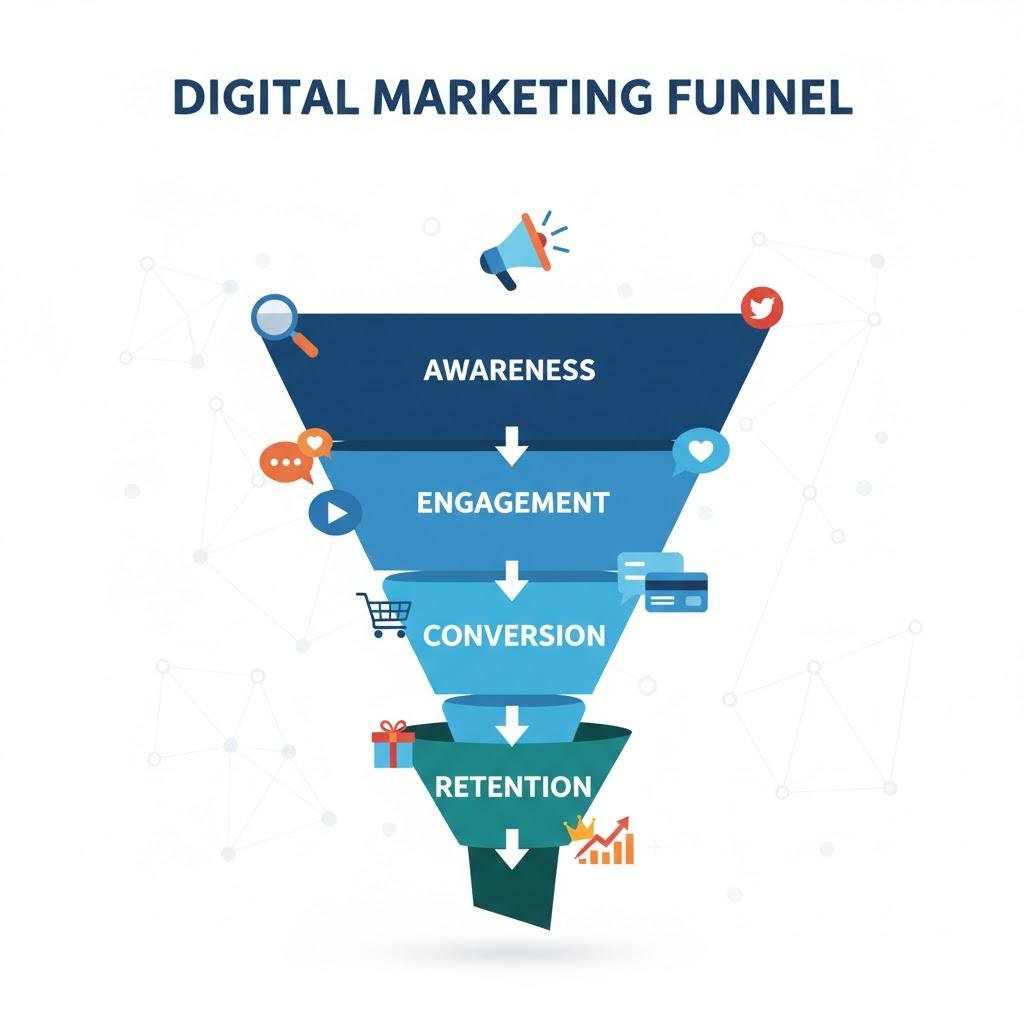
The Brand Awareness to Business Growth Funnel
A useful way to think about the entire process is as a funnel:
Awareness → Engagement → Consideration → Conversion → Retention → Advocacy
Awareness
People discover your brand.
Engagement
They interact with your content, website, or social channels.
Consideration
They start evaluating your business against alternatives.
Conversion
They become a lead or customer.
Retention
You provide enough value to encourage them to stay.
Advocacy
Satisfied customers recommend your brand to others.
This is how brand awareness can contribute to long-term business growth.
The objective isn’t simply to get more people into the top of the funnel.
It’s to create a system that moves qualified people toward meaningful business outcomes.
Common Mistakes That Stop Brand Awareness From Driving Growth
Even strong awareness campaigns can fail to generate business results when businesses make certain mistakes.
Focusing Only on Reach
A large audience isn’t automatically a valuable audience.
Having No Clear CTA
If people don’t know what to do next, they may simply move on.
Inconsistent Messaging
Mixed messages can weaken brand recognition and trust.
Ignoring Existing Audiences
Businesses sometimes spend heavily on acquiring new audiences while neglecting people who have already interacted with them.
Not Measuring Conversions
Without conversion data, it becomes difficult to know whether awareness is contributing to revenue.
Creating Content Without a Strategy
Posting frequently doesn’t necessarily mean you’re moving customers closer to a purchase.
The solution is to connect every major marketing activity to a specific objective.
How Long Does It Take for Brand Awareness to Generate Business Growth?
There isn’t a universal timeline.
The time required depends on factors such as:
- Industry
- Product price
- Competition
- Customer buying cycle
- Marketing budget
- Audience size
- Brand credibility
- Marketing consistency
A low-cost consumer product may have a much shorter decision-making process than a high-value B2B service.
That’s why businesses should avoid judging brand awareness campaigns only by short-term sales.
Instead, monitor the complete customer journey and look for improvements in awareness, engagement, consideration, leads, conversions, and retention.
How to Create a Brand Awareness Strategy That Drives Results
A practical approach is to start with five questions:
1. Who are we trying to reach?
Define your ideal audience.
2. What problem do we solve?
Identify the core customer need.
3. What should people remember about us?
Create a clear brand message.
4. What should they do after discovering us?
Build a clear customer journey and CTA.
5. How will we measure success?
Connect awareness metrics with leads, conversions, revenue, and other business objectives.
This transforms brand awareness from a vague marketing goal into a measurable growth strategy.
Frequently Asked Questions
What is the difference between brand awareness and business growth?
Brand awareness measures how familiar people are with your business, while business growth focuses on measurable outcomes such as customers, sales, revenue, and retention. Awareness can support growth when it is connected to a strong customer journey and conversion strategy.
How can brand awareness increase sales?
Brand awareness can increase sales by helping potential customers recognize, remember, and consider your business. When awareness is combined with trust-building content, strong offers, clear CTAs, and effective conversion strategies, it can contribute to increased sales.
What is the best strategy for increasing brand awareness?
There is no single best strategy for every business. A combination of valuable content, consistent branding, SEO, social media, video marketing, advertising, and customer-focused messaging can help build awareness among the right audience.
How do you measure brand awareness?
Brand awareness can be measured using metrics such as reach, impressions, brand searches, social mentions, website traffic, direct traffic, video views, and engagement. These metrics should be combined with conversion and revenue data to understand business impact.
Can small businesses turn brand awareness into sales?
Yes. Small businesses can build awareness and convert it into sales by focusing on a specific audience, creating useful content, building trust through reviews and testimonials, providing clear offers, and making it easy for prospects to take the next step.
Why is consistency important for brand awareness?
Consistent messaging, visual identity, and customer experience make it easier for people to recognize and remember a brand. Consistency across marketing channels can also strengthen credibility and trust.
Conclusion
Brand awareness is not the finish line. It is the starting point for business growth.
Getting your business noticed is valuable, but the real opportunity comes from what happens after people discover your brand.
You need to move audiences from awareness to engagement, from engagement to consideration, and from consideration to conversion. Then, by delivering a strong customer experience, you can turn customers into repeat buyers and brand advocates.
The most successful brands don’t simply ask, “How can we get more people to see us?”
They ask:
“How can we turn attention into trust, trust into action, and action into long-term growth?”
That’s where strategic marketing makes the difference.
At Lerdleap, the focus should not be on marketing activity for the sake of activity. The goal is to create connected strategies that help brands increase visibility, engage the right audiences, generate opportunities, and build sustainable business growth.
Because the real value of brand awareness isn’t simply being known.
It’s being chosen.