
Performance Marketing Hyderabad | ROI-Focused Google & Meta Ads Agency
Performance marketing isn’t about spending more—it is about making every rupee accountable.
At LerdLeap Media Collective, we help Hyderabad businesses generate qualified leads, increase sales, and improve return on ad spend using data-driven campaigns across Google Ads, Meta Ads, YouTube, and remarketing. Every campaign is built around measurable business goals instead of vanity metrics like impressions or likes.
Whether you’re a real estate developer, healthcare brand, education institute, eCommerce store, or local business, our Performance Marketing Hyderabad services focus on one thing: sustainable growth backed by measurable results.
Performance Marketing That Focuses on Business Outcomes
Many businesses believe running ads automatically brings customers. In reality, advertisements only create opportunities. What determines success is how every stage—from targeting to the landing page—works together.
A campaign generating 500 leads is not necessarily successful if only five people answer your calls.
Likewise, spending less doesn’t always mean saving money if the campaign fails to attract the right audience.
Our approach to Performance Marketing Hyderabad begins with understanding your business before launching any campaign. We identify who your customers are, what motivates them to enquire or purchase, and which advertising channels influence their decisions. This allows us to invest your budget where it creates measurable business impact rather than wasting it on broad audiences.
Instead of asking:
“How many clicks did we receive?”
we ask:
- How many qualified enquiries were generated?
- What was the cost per qualified lead?
- Which campaign produced actual revenue?
- Which audience converts consistently?
- Where are potential customers dropping off?
These questions reveal the real performance of your advertising.
Why Most Businesses Don’t Get Results From Paid Advertising
Many companies assume digital advertising is failing when, in reality, the problem lies in campaign execution.
Over the years, we’ve noticed the same issues repeatedly.
Problem 1: Targeting Everyone
Trying to reach everyone usually means reaching no one effectively.
Successful campaigns focus on specific audiences based on buying intent, interests, behaviour, demographics, location, and previous interactions.
Problem 2: Sending Traffic to Weak Landing Pages
Even excellent advertisements cannot compensate for confusing landing pages.
Visitors decide within seconds whether to stay or leave.
A slow website, unclear message, complicated forms, or poor mobile experience significantly reduces conversions.
Problem 3: Optimising for Clicks Instead of Customers
High click numbers may look impressive in reports but don’t always generate business.
We optimise campaigns around conversions, qualified leads, booked appointments, purchases, and actual revenue.
Problem 4: No Conversion Tracking
Without proper tracking, businesses often continue spending money on campaigns that aren’t producing results.
We implement accurate tracking to understand:
- Which keyword generated the enquiry
- Which advertisement performed best
- Which audience converts most often
- Which device delivers better ROI
- Which campaign deserves increased investment
Problem 5: No Continuous Optimisation
Performance marketing isn’t a “launch once and forget” strategy.
Every campaign requires ongoing improvements based on live data.
We continuously analyse:
- Search terms
- Audience quality
- Ad relevance
- Conversion rates
- Landing page behaviour
- Cost per acquisition
- Budget allocation
Small improvements every week often produce significant long-term gains.
What Makes Our Performance Marketing Hyderabad Approach Different?
Most agencies begin with advertising platforms.
We begin with your business.
Before creating campaigns, we understand:
- Business objectives
- Sales process
- Customer journey
- Competitive landscape
- Buying cycle
- Revenue goals
- Average customer value
- Lead qualification process
Only after understanding these fundamentals do we build advertising campaigns.
This prevents unnecessary spending and helps create campaigns aligned with business growth.
Our Performance Marketing Framework
Every successful campaign follows a structured process rather than guesswork.
Step 1: Business Discovery
We learn:
- Your products or services
- Ideal customers
- Sales process
- Current marketing challenges
- Existing campaigns
- Customer objections
- Business goals
This foundation influences every advertising decision.
Step 2: Market & Competitor Research
Instead of copying competitors, we identify opportunities they’ve overlooked.
We study:
- Customer search behaviour
- Competitor messaging
- Market demand
- Seasonal trends
- High-intent keywords
- Audience interests
This helps us position your business more effectively.
Step 3: Campaign Strategy
Every campaign receives a customised strategy including:
- Budget planning
- Platform selection
- Audience segmentation
- Campaign objectives
- Creative planning
- Conversion tracking
- Remarketing strategy
No two businesses receive identical campaign structures.
Step 4: Creative Development
Good advertisements combine:
- Strong headlines
- Clear value proposition
- Effective visuals
- Persuasive call-to-action
- Customer-focused messaging
Every creative is designed to encourage meaningful action.
Step 5: Landing Page Optimisation
Advertisements only succeed when landing pages convert visitors.
We improve:
- Page speed
- Mobile usability
- Trust signals
- Content clarity
- Forms
- Call-to-action placement
- User experience
Better landing pages reduce acquisition costs over time.
Step 6: Continuous Optimisation
Campaign performance changes daily.
We monitor:
- Search queries
- Audience behaviour
- Click-through rates
- Conversion rates
- Cost per lead
- Return on ad spend
- Revenue performance
These insights guide continuous improvements.
Google Ads Services
Google Ads reaches people already searching for products and services.
This makes it one of the highest-intent advertising platforms.
Our Google Ads services include:
Search Campaigns
Capture customers actively searching for your services.
Ideal for:
- Real estate
- Healthcare
- Education
- Local businesses
- Professional services
- B2B companies
Display Advertising
Increase brand visibility through visually engaging banner advertisements across Google’s network.
Performance Max Campaigns
Leverage Google’s AI while maintaining strategic oversight.
Performance Max campaigns can appear across:
- Search
- Display
- YouTube
- Gmail
- Discover
- Maps
We structure campaigns carefully to maintain control over budget and audience quality.
YouTube Advertising
Video advertising builds awareness while influencing purchasing decisions.
Ideal for:
- Product launches
- Brand storytelling
- Real estate walkthroughs
- Educational content
- Service demonstrations
Remarketing Campaigns
Many visitors don’t convert during their first visit.
Remarketing reconnects with potential customers who previously interacted with your website, helping recover missed opportunities.
Meta Ads Services
Meta platforms provide exceptional audience targeting.
Our Meta advertising services include campaigns across:
- Messenger
Campaign objectives include:
- Lead generation
- Website conversions
- App promotion
- Product sales
- Brand awareness
- Event registrations
Instead of relying solely on demographic targeting, we combine behavioural insights, interests, lookalike audiences, customer lists, and engagement history to reach more relevant users.
Landing Page Optimisation
Advertising and landing pages should work together.
Many businesses spend thousands driving traffic to pages that don’t clearly explain their offer or encourage action.
We optimise every landing page around visitor intent.
Our improvements include:
- Faster loading speed
- Clear messaging
- Better visual hierarchy
- Simplified enquiry forms
- Trust-building content
- Mobile responsiveness
- Stronger calls to action
Improving conversion rates often delivers better ROI than simply increasing advertising budgets.
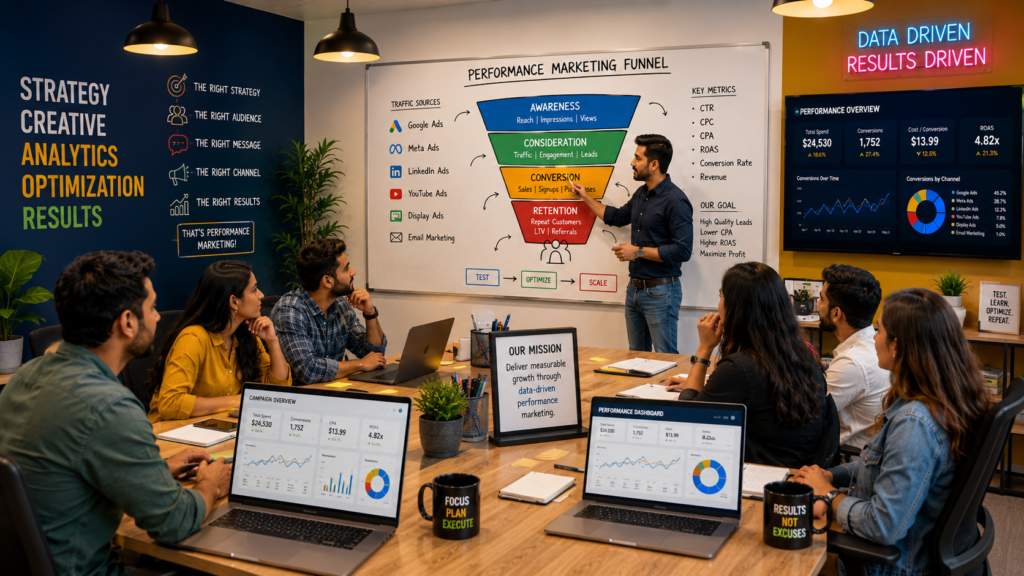
Performance Tracking That Businesses Can Actually Understand
Marketing reports should answer business questions, not overwhelm you with metrics.
Instead of presenting hundreds of numbers, we focus on insights such as:
- Total enquiries generated
- Qualified leads
- Cost per lead
- Conversion rate
- Revenue attributed to campaigns
- Best-performing audiences
- Highest-converting keywords
- Budget recommendations
This helps business owners make informed decisions without interpreting complex dashboards.
Industries We Serve
Our Performance Marketing Hyderabad services are tailored for businesses with different sales cycles and customer behaviours.
We work with:
- Real Estate Developers
- Healthcare & Hospitals
- Educational Institutions
- IT & SaaS Companies
- eCommerce Brands
- Manufacturing Businesses
- Financial Services
- Restaurants & Cafés
- Retail Stores
- Home Services
- Professional Consultants
- Startups
- Local Businesses
Each industry requires different messaging, targeting, and optimisation strategies. We build campaigns accordingly instead of applying a one-size-fits-all approach.
Why Businesses Choose LerdLeap
Businesses choose us because we focus on outcomes that matter.
Our approach includes:
- ROI-driven campaign strategy
- Transparent reporting
- Continuous optimisation
- Conversion-focused landing pages
- Accurate conversion tracking
- Multi-platform advertising
- Local market understanding
- Data-backed decision making
- Long-term growth strategy
Every recommendation is based on measurable data rather than assumptions.
Ready to Grow With Smarter Advertising?
If your business is investing in digital advertising without knowing exactly what return it’s generating, it’s time for a different approach.
Our Performance Marketing Hyderabad services combine strategy, creative, data analysis, and continuous optimisation to help businesses attract higher-quality leads, reduce wasted ad spend, and improve long-term ROI.
Let’s build campaigns that don’t just generate traffic—but generate measurable business growth.
Some campaigns begin generating leads within days, but meaningful optimisation typically occurs over several weeks. Performance improves as data accumulates and campaigns are refined.
Yes. Smaller businesses often benefit from measurable campaigns because budgets can be allocated to the channels and audiences delivering the highest returns.
Depending on your objectives, we manage campaigns across Google Ads, Meta Ads, LinkedIn Ads, YouTube, and other relevant digital advertising platforms.
We evaluate performance using business-focused metrics such as qualified leads, customer acquisition cost, conversion rate, return on ad spend, revenue contribution, and overall profitability.
Yes. Marketing performance improves when advertising and sales teams work together. We regularly align campaign insights with sales feedback to improve lead quality and conversion rates.
Search
Categories
Tags
All Services
- Digital Marketing Agency in Hyderabad That Focuses on Business Growth
- Experiential Marketing Agency: Crafting Immersive Brand Experiences
- Traditional Marketing Agency: Maximizing Your Brand’s Reach
- Creative Marketing Agency: Transforming Ideas into Impactful Experiences
- Performance Marketing Hyderabad | ROI-Focused Google & Meta Ads Agency
- Reputation & Brand Management