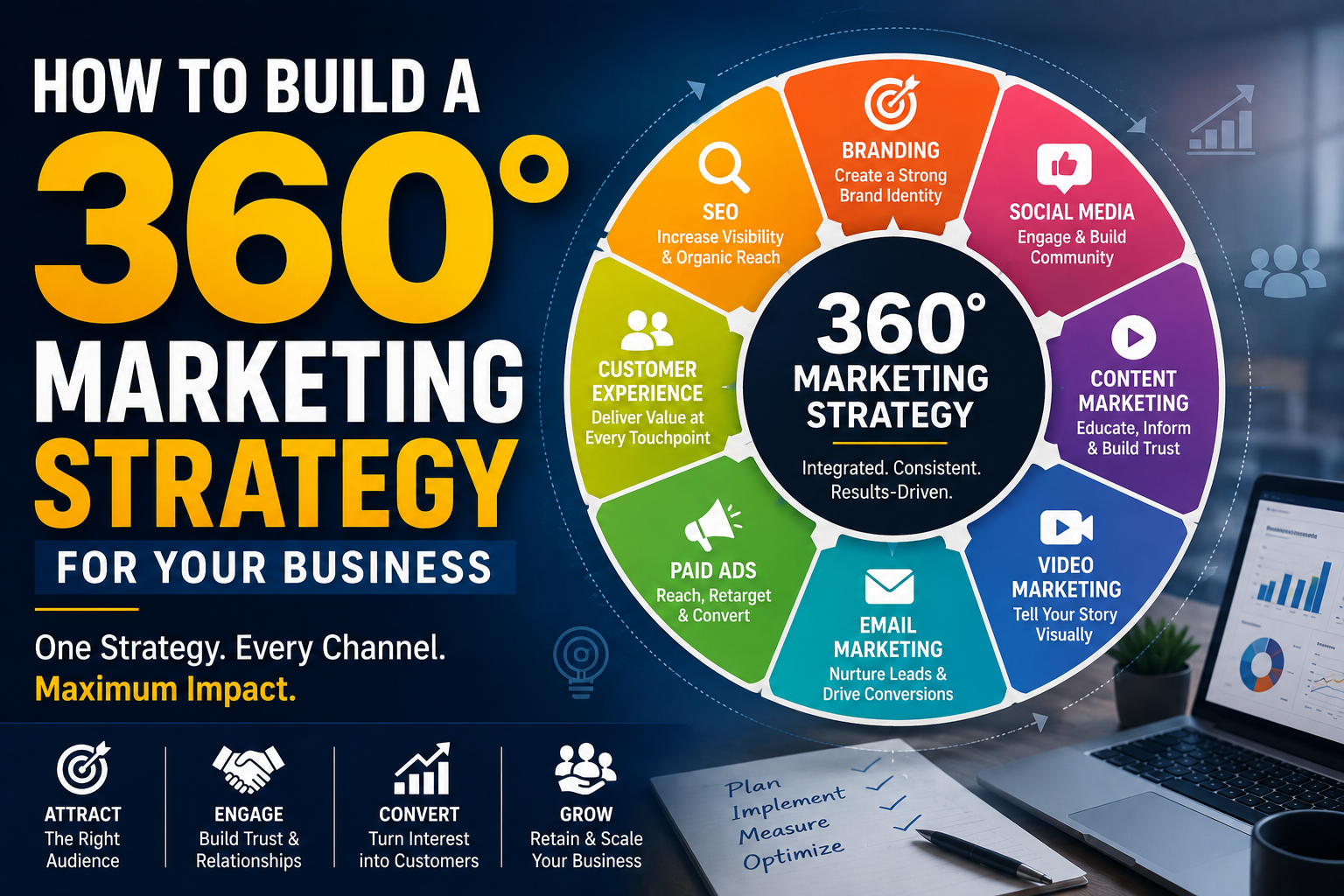

How to Build a 360° Marketing Strategy for Your Business
Marketing today is no longer about choosing just one channel.
A business cannot rely only on social media.
SEO alone may not be enough.
Running ads without strong branding can limit long-term growth.
And creating great content without a clear conversion strategy may generate attention without generating customers.
This is where a 360° marketing strategy becomes important.
A 360° marketing strategy brings multiple marketing channels together into one connected system. Instead of treating SEO, social media, content, paid advertising, email marketing, video, and branding as separate activities, the strategy ensures they work toward the same business goals.
The result is a more consistent customer experience.
A potential customer might discover your brand on Instagram, search for you on Google, visit your website, read a blog, watch a video, see an advertisement, subscribe to your email list, and eventually become a customer.
Every touchpoint plays a role.
That is the purpose of a 360° marketing strategy.
In this guide, you will learn how to build a 360° marketing strategy for your business, step by step.
What Is a 360° Marketing Strategy?
A 360° marketing strategy is an integrated approach that uses multiple marketing channels to reach customers at different stages of their journey.
These channels may include:
- Branding
- Website and conversion optimization
- Search engine optimization
- Content marketing
- Social media marketing
- Video marketing
- Paid advertising
- Email marketing
- Influencer marketing
- Public relations
- Offline marketing
The goal is not to use every channel available.
The goal is to choose the right channels and connect them.
For example, imagine a customer journey like this:
Instagram Reel → Website → Blog → Google Search → Retargeting Ad → Email → Purchase
Every channel supports the next step.
Instead of isolated campaigns, your marketing becomes a connected ecosystem.
That is what makes a 360° marketing strategy powerful.
Why Your Business Needs a 360° Marketing Strategy
Customers rarely make decisions after seeing a brand only once.
They research.
They compare.
They read reviews.
They search for answers.
They follow brands on social media.
They may leave a website and return weeks later.
A multi-channel strategy helps businesses stay present throughout this journey.
The main benefits include:
Better Brand Awareness
Using multiple channels increases the number of opportunities for people to discover your business.
Stronger Brand Consistency
A connected strategy ensures your messaging, visuals, and positioning remain consistent.
More Customer Touchpoints
Your audience can interact with your business through search, social media, email, video, and other channels.
Better Conversion Opportunities
Different customers prefer different channels. A 360° strategy gives them multiple ways to engage.
Reduced Dependence on One Platform
If your entire business depends on one social media platform or one advertising channel, you are vulnerable to algorithm changes and rising costs.
A diversified marketing strategy creates a more stable growth system.
Step 1: Start With Clear Business Goals
Before creating content or running advertisements, define what you want marketing to achieve.
Your goals might include:
- Increasing brand awareness
- Generating leads
- Increasing website traffic
- Improving sales
- Launching a new product
- Entering a new market
- Building customer loyalty
Your marketing activities should connect directly to these objectives.
For example:
Goal: Generate More Leads
Your strategy might focus on:
SEO + Google Ads + Landing Pages + Lead Magnets + Email Follow-ups
Goal: Build Brand Awareness
Your strategy might focus on:
Social Media + Video Content + Influencer Marketing + PR + Paid Reach
Goal: Increase Customer Retention
Your strategy might focus on:
Email + Customer Education + Loyalty Programs + Community Content
Without clear goals, marketing becomes random activity.
A 360° strategy should begin with the destination.
Then choose the channels that help you get there.
Step 2: Understand Your Target Audience
The best marketing strategy starts with understanding the customer.
Before deciding where to market, understand:
- Who your ideal customers are
- What problems they face
- What motivates them
- What questions they ask
- What objections they have
- Where they spend time
- How they make purchasing decisions
You should also understand the difference between audiences.
For example, a business may have:
- First-time customers
- Returning customers
- High-value customers
- Price-sensitive customers
- Business customers
- Individual consumers
Each group may require different messaging.
A good starting point is to create a simple customer profile:
Who are they?
What do they need?
What problem are they trying to solve?
Why might they choose a competitor?
What would convince them to choose you?
Once you understand this, choosing the right marketing channels becomes easier.
Step 3: Define Your Brand Positioning
Your marketing will struggle if people cannot understand what makes your business different.
Brand positioning answers an important question:
Why should customers choose you?
Your positioning should clearly communicate:
- What you offer
- Who it is for
- What problem you solve
- What makes you different
- Why customers should trust you
For example, compare:
“We provide digital marketing services.”
with:
“We help growing businesses build a complete digital presence that turns attention into measurable growth.”
The second message provides more context and direction.
Your positioning should guide every marketing channel.
Your website, advertisements, videos, social media posts, and emails should all communicate a consistent message.
Step 4: Build a Strong Website as Your Marketing Hub
Your website should act as the centre of your marketing ecosystem.
Social media platforms can change.
Algorithms can change.
Advertising costs can increase.
But your website is an owned digital asset.
Every major marketing channel should have a clear connection to it.
Your website should include:
- A clear value proposition
- Easy navigation
- Mobile-friendly design
- Service or product pages
- Educational content
- Trust signals
- Testimonials
- Strong calls to action
- Fast-loading pages
A customer arriving from Google should understand what to do next.
The same should be true for someone arriving from Instagram, YouTube, LinkedIn, or a paid advertisement.
Do not think of your website as an online brochure.
Think of it as your digital headquarters.
Step 5: Build an SEO and Content Foundation
Search engine optimization helps potential customers discover your business when they actively search for information.
A strong SEO strategy should include:
Keyword Research
Identify what your audience is searching for.
Focus on:
- Informational searches
- Commercial searches
- Comparison searches
- Problem-based searches
- Local searches
Content Strategy
Create useful content that answers customer questions.
For example:
Top of Funnel:
“What is a 360° marketing strategy?”
Middle of Funnel:
“360° marketing strategy vs traditional marketing”
Bottom of Funnel:
“Best marketing agency for business growth”
This creates a content journey.
Technical SEO
Ensure your website is:
- Fast
- Mobile-friendly
- Easy to crawl
- Properly structured
- Secure
SEO takes time.
But it can create a long-term source of relevant traffic.
Step 6: Use Social Media to Build Attention and Relationships
Social media is not just a place to promote products.
It can help businesses build familiarity.
Your social media strategy should include different types of content.
Educational Content
Teach your audience something useful.
Brand Content
Show your people, culture, story, and values.
Engagement Content
Start conversations and encourage interaction.
Authority Content
Share insights, opinions, research, and expertise.
Conversion Content
Promote products, services, offers, and calls to action.
Not every platform will be right for every business.
Choose platforms based on your audience.
For example:
- LinkedIn may be useful for B2B companies.
- Instagram may work well for visual consumer brands.
- YouTube may support educational and long-form content.
- Short-form video may help businesses increase discovery.
The goal is not to be everywhere.
The goal is to be effective where your customers already spend time.
Step 7: Add Video to Your Marketing Strategy
Video can support almost every stage of the marketing funnel.
Use video for:
- Brand awareness
- Product demonstrations
- Customer testimonials
- Educational content
- Behind-the-scenes stories
- Social media discovery
- Sales support
One strong long-form video can also be repurposed into:
- Short-form clips
- Blog content
- Social posts
- Email content
- Website content
This makes video one of the most flexible marketing assets.
Your video strategy should answer one question:
What does our audience need to see to better understand and trust our brand?
Step 8: Use Paid Advertising Strategically
Organic marketing builds long-term visibility.
Paid advertising can accelerate results.
A 360° marketing strategy may include:
- Google Ads
- Social media advertising
- Display advertising
- Video advertising
- Retargeting campaigns
But do not run ads simply to generate traffic.
Every campaign should have a clear purpose.
For example:
Awareness Ads
Introduce your brand to new audiences.
Consideration Ads
Promote educational content, case studies, or product benefits.
Conversion Ads
Encourage users to:
- Buy
- Book
- Contact
- Register
- Request a quote
Retargeting Ads
Reconnect with people who already visited your website or engaged with your content.
Paid advertising works best when it connects with the rest of your marketing system.
Do not send paid traffic to a weak website.
Do not promote content with no clear purpose.
Create a journey.
Step 9: Build an Email Marketing System
Email remains one of the most useful channels for nurturing relationships.
Not everyone will become a customer immediately.
Email allows your business to continue the conversation.
You can use email for:
- Educational content
- Product updates
- Offers
- Case studies
- Customer onboarding
- Re-engagement
- Retention
A basic email journey might look like this:
Website Visitor → Lead Magnet → Email Signup → Educational Emails → Trust Building → Offer → Conversion
The key is relevance.
Do not send emails simply because you have a mailing list.
Send content that helps customers move toward a decision.
Step 10: Connect Online and Offline Marketing
A true 360° strategy does not have to exist only online.
Depending on your business, offline marketing may also play an important role.
This could include:
- Events
- Billboards
- Print advertising
- Radio
- Television
- Networking
- Sponsorships
These activities can connect with digital channels.
For example:
Billboard → QR Code → Landing Page
Event → Email Signup → Follow-up Campaign
Print Advertisement → Website → Retargeting Campaign
This creates a connected experience between the physical and digital world.
Step 11: Map the Complete Customer Journey
One of the most important parts of a 360° marketing strategy is understanding how customers move from awareness to action.
A simple customer journey might look like this:
Awareness
The customer discovers your brand.
Channels:
- Social media
- SEO
- Video
- PR
- Advertising
Consideration
The customer learns more.
Channels:
- Website
- Blogs
- Case studies
- Videos
Conversion
The customer takes action.
Channels:
- Landing pages
- Sales calls
- Retargeting
- Offers
Retention
The customer continues the relationship.
Channels:
- Customer support
- Educational content
- Community
- Loyalty programs
Mapping this journey helps you identify gaps.
For example, you may have excellent awareness content but no follow-up system.
Or you may have strong advertising but weak conversion pages.
A 360° strategy connects these gaps.
Step 12: Create a Unified Content Strategy
Your content should not feel disconnected.
Create content pillars based on your audience and business goals.
For example, a marketing company might use:
Pillar 1: Digital Marketing Education
SEO, advertising, social media, and content tips.
Pillar 2: Business Growth
Strategies, case studies, and marketing insights.
Pillar 3: Brand Building
Positioning, storytelling, and brand identity.
Pillar 4: Video and Content
How businesses can use content to grow.
Each pillar can generate multiple pieces of content.
One topic can become:
- A blog
- A video
- Several short-form videos
- A LinkedIn post
- An Instagram carousel
- An email newsletter
This creates consistency without constantly searching for new ideas.
Step 13: Measure the Entire Marketing System
Do not evaluate every marketing channel in isolation.
A customer may first discover you on social media but later convert through Google search.
If you only look at the final click, you may underestimate the value of social media.
Measure:
- Brand awareness
- Website traffic
- Organic traffic
- Engagement
- Leads
- Conversion rates
- Cost per acquisition
- Customer retention
- Revenue
Look for patterns across channels.
Ask:
- Where are customers discovering us?
- Where are they dropping off?
- Which content influences conversions?
- Which channels produce high-quality leads?
- Which campaigns are profitable?
The goal is continuous improvement.
Common Mistakes to Avoid When Building a 360° Marketing Strategy
Avoid these common mistakes:
Trying to Use Every Marketing Channel
More channels do not automatically mean better results.
Start with the channels most relevant to your audience.
Inconsistent Messaging
Your brand should not sound completely different on every platform.
Ignoring the Website Experience
A strong campaign can fail if the destination is weak.
Focusing Only on Short-Term Results
Balance immediate lead generation with long-term brand building.
Not Tracking Performance
Measure what contributes to real business outcomes.
Working in Marketing Silos
SEO, content, social media, and advertising teams should support the same overall strategy.
A Simple 360° Marketing Strategy Framework
Use this framework:
1. Goals
What does the business want to achieve?
↓
2. Audience
Who are we trying to reach?
↓
3. Positioning
Why should they choose us?
↓
4. Content
What information will attract and educate them?
↓
5. Channels
Where will we reach them?
↓
6. Conversion
What action should they take?
↓
7. Retention
How do we keep the relationship going?
↓
8. Measurement
How will we improve results?
This creates a complete marketing system.
Final Thoughts: Marketing Works Better When Everything Is Connected
A 360° marketing strategy is not about doing everything.
It is about connecting the right things.
Your SEO should support your content.
Your content should support your social media.
Your social media should build awareness.
Your paid advertising should accelerate the right campaigns.
Your website should convert interest into action.
Your email marketing should nurture relationships.
And your branding should create consistency across every customer touchpoint.
When these elements work independently, marketing can feel fragmented.
When they work together, every activity becomes more valuable.
The most successful businesses do not simply ask:
“Which marketing channel should we use?”
They ask:
“How can every marketing channel work together to move the customer closer to choosing our brand?”
That is the real power of a 360° marketing strategy.
Take Your Brand Further with Lerdleap
At Lerdleap, we help businesses build connected marketing strategies that bring every important touchpoint together. From branding and website strategy to SEO, content, video, social media, paid advertising, and performance marketing, we create integrated approaches designed to attract the right audience, build trust, and drive sustainable business growth.
Ready to build a marketing strategy where every channel works together? Lerdleap is here to help you take the next leap.