
How to Combine Online and Offline Marketing for Maximum Brand Visibility
Marketing is often divided into two separate worlds.
The first is online marketing.
This includes SEO, social media, Google Ads, content marketing, email campaigns, websites, video marketing, and other digital channels.
The second is offline marketing.
This includes print advertising, billboards, events, radio, television, direct mail, networking, sponsorships, and other traditional channels.
Many businesses make the mistake of choosing one over the other.
They either focus entirely on digital marketing because that is where modern audiences spend their time, or they continue relying heavily on traditional advertising because it has worked for them in the past.
But the strongest strategy does not always involve choosing between online and offline marketing.
It involves connecting them.
When digital and traditional marketing work together, businesses can create more touchpoints, increase brand visibility, build trust, and guide customers through a more complete journey.
For example, a potential customer may first see your billboard while driving to work. Later, they search for your brand on Google. They visit your website, follow you on Instagram, watch a video, and eventually contact your business.
That is not two separate marketing strategies.
That is one connected customer journey.
In this guide, you will learn how to combine online and offline marketing for maximum brand visibility and business growth.
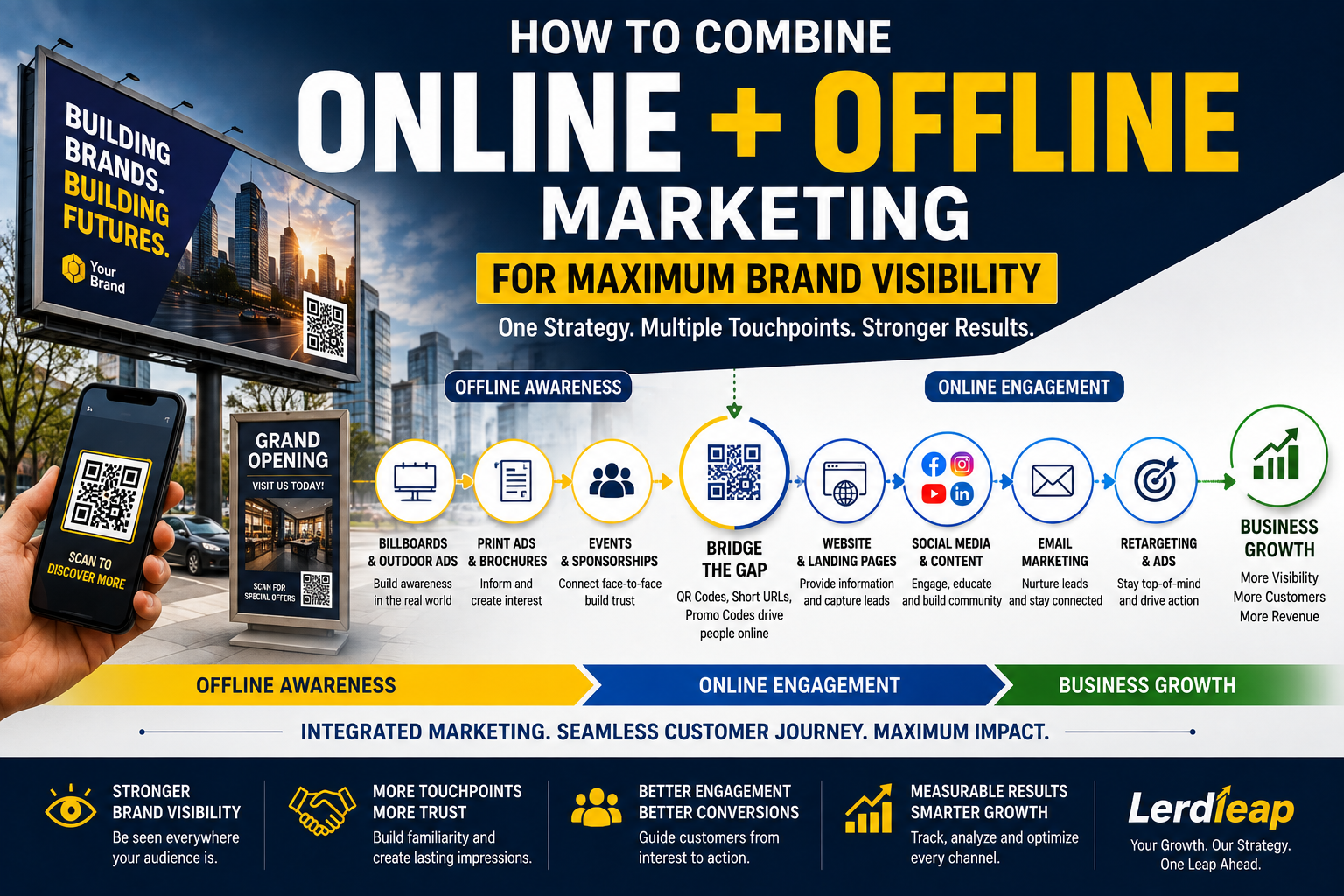
Online and offline marketing are often treated as separate strategies, but combining them can help businesses create a stronger and more connected brand experience.
What Is Integrated Online and Offline Marketing?
Integrated online and offline marketing means connecting your digital and traditional marketing activities so they support the same brand message and business goals.
Instead of treating every channel separately, you create a connected marketing ecosystem.
For example:
Billboard → QR Code → Landing Page → Email Signup → Follow-Up Campaign
Or:
Event → Social Media Content → Website → Retargeting Ads → Lead Conversion
Or:
Print Advertisement → Branded Search → Website → Product Demo → Purchase
Every marketing activity plays a role.
Offline marketing can create awareness.
Online marketing can provide more information.
Digital channels can nurture the relationship.
Sales and conversion systems can turn interest into action.
The goal is to create a seamless experience between the physical and digital worlds.
A successful online and offline marketing strategy connects digital platforms with physical customer touchpoints to create a seamless journey.
Why Businesses Should Combine Online and Offline Marketing
Customers do not think in terms of online and offline channels.
They simply interact with brands.
A customer may discover your business through a billboard and later research you online.
Another customer may find your Instagram page first but visit your physical store before making a purchase.
This is why businesses need to think about the complete customer journey.
Combining online and offline marketing can help create:
Greater Brand Visibility
Your business appears in multiple places where potential customers may encounter it.
More Customer Touchpoints
The more relevant interactions customers have with your brand, the more familiar they can become with it.
Better Brand Recognition
Consistent messaging across physical and digital channels makes your brand easier to remember.
Stronger Trust
A brand that appears consistently across websites, social media, events, advertising, and physical spaces can create a stronger sense of credibility.
Better Conversion Opportunities
Offline marketing can generate awareness, while online channels can capture, nurture, and convert that interest.
Combining online and offline marketing allows brands to reach customers both in digital spaces and in the physical world.
Step 1: Start With One Clear Brand Message
Before combining multiple marketing channels, make sure your brand message is clear.
Your audience should receive a consistent experience whether they see your:
- Instagram advertisement
- Google search result
- Billboard
- Print advertisement
- Event booth
- Website
- YouTube video
- Sales presentation
Your message does not have to be identical everywhere.
But the core positioning should remain consistent.
For example, if your brand is positioned around:
“Helping businesses build smarter marketing strategies.”
Your billboard might say:
Build Smarter. Grow Faster.
Your social media content could focus on practical marketing insights.
Your website could explain how your services help businesses grow.
Your email campaigns could provide strategic advice and case studies.
Different formats.
One clear message.
This consistency helps build brand recognition.
Step 2: Use Offline Marketing to Create Online Action
One of the best ways to connect traditional and digital marketing is to give offline audiences a clear online action.
Instead of simply displaying your company name and phone number, encourage people to continue their journey digitally.
You can use:
- QR codes
- Short URLs
- Branded hashtags
- Landing pages
- Promotional codes
- Social media handles
- Event registration links
For example:
Billboard
Thinking About Buying Your First Home?
Scan to Get the Complete Buyer’s Guide
↓
Landing Page
Customer enters their details to download the guide.
↓
Email Campaign
The customer receives helpful content about buying a home.
↓
Retargeting
Relevant ads remind them about your service.
↓
Conversion
The customer books a consultation.
A single offline advertisement has now become part of a complete digital marketing system.
One of the biggest advantages of online and offline marketing is the ability to turn physical brand awareness into measurable digital engagement.
Step 3: Use QR Codes Strategically
QR codes have made it easier to connect physical marketing with digital experiences.
You can use QR codes on:
- Billboards
- Posters
- Brochures
- Business cards
- Product packaging
- Event displays
- Store signage
- Print advertisements
However, simply adding a QR code is not enough.
Give people a reason to scan it.
Instead of:
Scan Here
Try:
- Scan to Get Your Free Guide
- Scan to See the Full Collection
- Scan to Unlock an Exclusive Offer
- Scan to Book a Free Consultation
- Scan to Watch the Full Story
The destination should also be relevant.
Do not send every QR code to your homepage.
Create a dedicated landing page based on the specific campaign.
QR codes have become a simple but effective bridge between online and offline marketing campaigns.
Step 4: Turn Offline Events Into Digital Content
Events create excellent opportunities for digital content.
A single event can generate:
- Short-form videos
- Interviews
- Behind-the-scenes content
- Customer testimonials
- Photos
- Live updates
- Blog content
- Email newsletters
For example, if your business hosts an event, you can:
Before the Event
Use social media and email to promote it.
During the Event
Create live content, interviews, and behind-the-scenes videos.
After the Event
Publish highlights, testimonials, blogs, and videos.
The event no longer exists for only a few hours.
It can continue creating marketing value for weeks or months.
This approach helps businesses get more value from offline activities.
Events demonstrate how online and offline marketing can work together long after the physical event has ended.
Step 5: Connect Print Advertising With Digital Campaigns
Print advertising does not have to exist independently from your digital strategy.
A newspaper, magazine, brochure, or flyer can direct customers toward digital content.
For example:
Print Ad → Landing Page → Lead Capture → Email Campaign
A real estate company might publish a property advertisement in a magazine.
Instead of trying to include every property detail in the advertisement, it could include:
Explore the Full Property Tour
with a QR code.
The customer is then taken to:
- A video tour
- Property images
- Pricing information
- Location details
- A lead form
This allows the offline advertisement to generate measurable digital activity.
Businesses can use online and offline marketing together by connecting print advertisements to targeted digital experiences.
Step 6: Use Social Media to Amplify Offline Campaigns
Your offline marketing campaigns can become much more powerful when supported by social media.
For example, if you are launching:
- A billboard campaign
- A new store
- A product event
- A sponsorship
- An exhibition
Create digital content around it.
Show the behind-the-scenes process.
Share the launch.
Interview customers.
Create short videos.
Encourage user-generated content.
A billboard can become an Instagram Reel.
An event can become a YouTube video.
A sponsorship can become a content series.
This helps extend the reach of your offline investment.
Social media can amplify online and offline marketing campaigns by extending the reach of physical advertising.
Step 7: Connect Physical Stores With Digital Marketing
For businesses with physical locations, the customer experience should connect both worlds.
A customer may:
- Discover your brand online.
- Research your products.
- Visit the physical location.
- Make a purchase.
- Receive follow-up communication online.
Or the journey may happen in reverse.
They may first visit the store and later follow your brand online.
To create a connected experience, use:
- QR codes in-store
- Social media promotions
- Digital loyalty programs
- Email signups
- Customer reviews
- Online product information
- Location-based campaigns
The goal is to make it easy for customers to move between physical and digital experiences.
Step 8: Use Location-Based Digital Advertising
Offline campaigns can be supported by targeted digital advertising.
For example, imagine launching a billboard campaign in Hyderabad.
You could simultaneously run digital ads targeting people in relevant nearby areas.
This creates repeated exposure.
The customer may:
See the Billboard → Later See a Social Ad → Search the Brand → Visit the Website
This combination can increase familiarity.
Your offline campaign creates physical visibility.
Your digital campaign keeps the brand present online.
The key is coordination.
The messaging, visuals, offer, and campaign objective should support each other.
Coordinating location-based ads with physical campaigns creates a stronger online and offline marketing strategy.
Step 9: Create Campaign-Specific Landing Pages
One common mistake is directing every marketing campaign to the homepage.
Instead, create dedicated landing pages.
For example:
Billboard Campaign
yourbrand.com/hyderabad
Event Campaign
yourbrand.com/event
Product Launch
yourbrand.com/new
Each landing page can have:
- A relevant headline
- Campaign-specific information
- A clear offer
- A simple call to action
- A form or conversion option
This creates a more relevant experience and makes campaign performance easier to measure.
Step 10: Measure Offline Marketing Through Digital Actions
Traditional marketing has often been considered difficult to measure.
But digital tools can help businesses understand how offline campaigns influence customer behaviour.
You can track:
- QR code scans
- Landing page visits
- Branded searches
- Promotional code usage
- Event registrations
- Website traffic increases
- Social media engagement
- Location-based conversions
For example, if you launch a new billboard campaign and notice an increase in:
- Searches for your brand
- Website traffic
- QR scans
- Direct enquiries
you can begin understanding the campaign’s impact.
This makes offline marketing more measurable.
Modern tracking tools make it easier to measure the impact of online and offline marketing activities.
Step 11: Use Consistent Visual Branding Everywhere
Your brand should be recognizable across every channel.
Use consistent:
- Logo placement
- Typography
- Colours
- Messaging
- Photography style
- Tone of voice
Imagine a customer seeing a minimalist premium billboard and then visiting a website that looks completely different.
The experience can feel disconnected.
Consistency creates familiarity.
The goal is not to make every piece of marketing look identical.
The goal is to make every touchpoint feel like it belongs to the same brand.
Step 12: Build Campaigns Around One Big Idea
The most effective integrated campaigns often start with one strong idea.
That central idea can then be adapted for different channels.
For example:
Campaign Idea
“Your Business Deserves to Be Seen.”
This could become:
Billboard
Be Seen.
Social Media
A series about businesses improving their visibility.
Video
Customer stories about growth.
Blog
How businesses can improve brand visibility.
Marketing tips for reaching more customers.
Event
A business visibility workshop.
One central message.
Multiple channels.
This creates a connected campaign instead of disconnected marketing activities.
A Simple Online + Offline Marketing Framework
You can build your strategy using this process:
1. Create Awareness
Use:
- Billboards
- Social media
- Video
- PR
- Events
- Influencer campaigns
↓
2. Capture Interest
Use:
- QR codes
- Landing pages
- Websites
- Lead magnets
- Event registrations
↓
3. Build Trust
Use:
- Blogs
- Videos
- Case studies
- Testimonials
- Email marketing
↓
4. Drive Conversion
Use:
- Retargeting ads
- Sales calls
- Offers
- Consultations
- Product demonstrations
↓
5. Build Retention
Use:
- Loyalty programs
- Community
- Customer education
- Exclusive offers
This framework helps connect every activity to the customer journey.
Examples of Online and Offline Marketing Working Together
Example 1: Retail Brand
Offline: Store promotion and outdoor advertising.
Online: Instagram campaign, influencer content, location-based ads, and a digital loyalty program.
The customer discovers the brand offline and continues interacting online.
Example 2: Real Estate Company
Offline: Billboards, property events, brochures, and exhibitions.
Online: Property videos, Google Ads, landing pages, SEO, social media, and retargeting.
The physical campaign creates awareness.
Digital channels provide detailed information and capture leads.
Example 3: B2B Company
Offline: Industry conference or networking event.
Online: LinkedIn content, event landing page, email follow-ups, webinars, and case studies.
The event creates personal connections.
Digital marketing continues the conversation.
Common Mistakes to Avoid
Treating Online and Offline Teams Separately
Both activities should support the same business objectives.
Using Different Brand Messages
Customers should recognize the same core brand across every touchpoint.
Sending Offline Traffic to a Generic Homepage
Create relevant landing pages.
Not Tracking Campaign Performance
Use QR codes, unique URLs, promotional codes, and campaign tracking.
Focusing Only on Awareness
Create a clear next step for customers.
Using Too Many Channels
Start with the channels that make sense for your audience and business.
Final Thoughts: The Best Marketing Strategy Connects Every Customer Touchpoint
Online and offline marketing should not compete with each other.
They can support each other.
Offline marketing can create physical presence, credibility, and large-scale awareness.
Online marketing can provide detailed information, capture interest, nurture relationships, and measure performance.
When both are connected, businesses can create a stronger and more consistent brand experience.
The goal is not to be everywhere.
It is to create meaningful visibility where your customers are likely to encounter and engage with your brand.
A billboard can lead to a website.
An event can create a content campaign.
A brochure can generate a digital lead.
A social media campaign can bring customers into a physical store.
When every channel has a purpose and every touchpoint is connected, marketing becomes more than a collection of advertisements.
It becomes one complete brand experience.
The future of effective brand building lies in connecting online and offline marketing rather than treating them as separate strategies.
Take Your Brand Further with Lerdleap
At Lerdleap, we help businesses connect digital and traditional marketing into one unified growth strategy. From SEO, content, social media, video, and paid campaigns to branding, events, and offline advertising, we focus on creating consistent experiences that increase visibility and move customers closer to your brand.
Ready to make your online and offline marketing work together? Lerdleap can help you build a strategy where every touchpoint contributes to growth.
At Lerdleap, we help businesses build online and offline marketing strategies that connect every customer touchpoint.