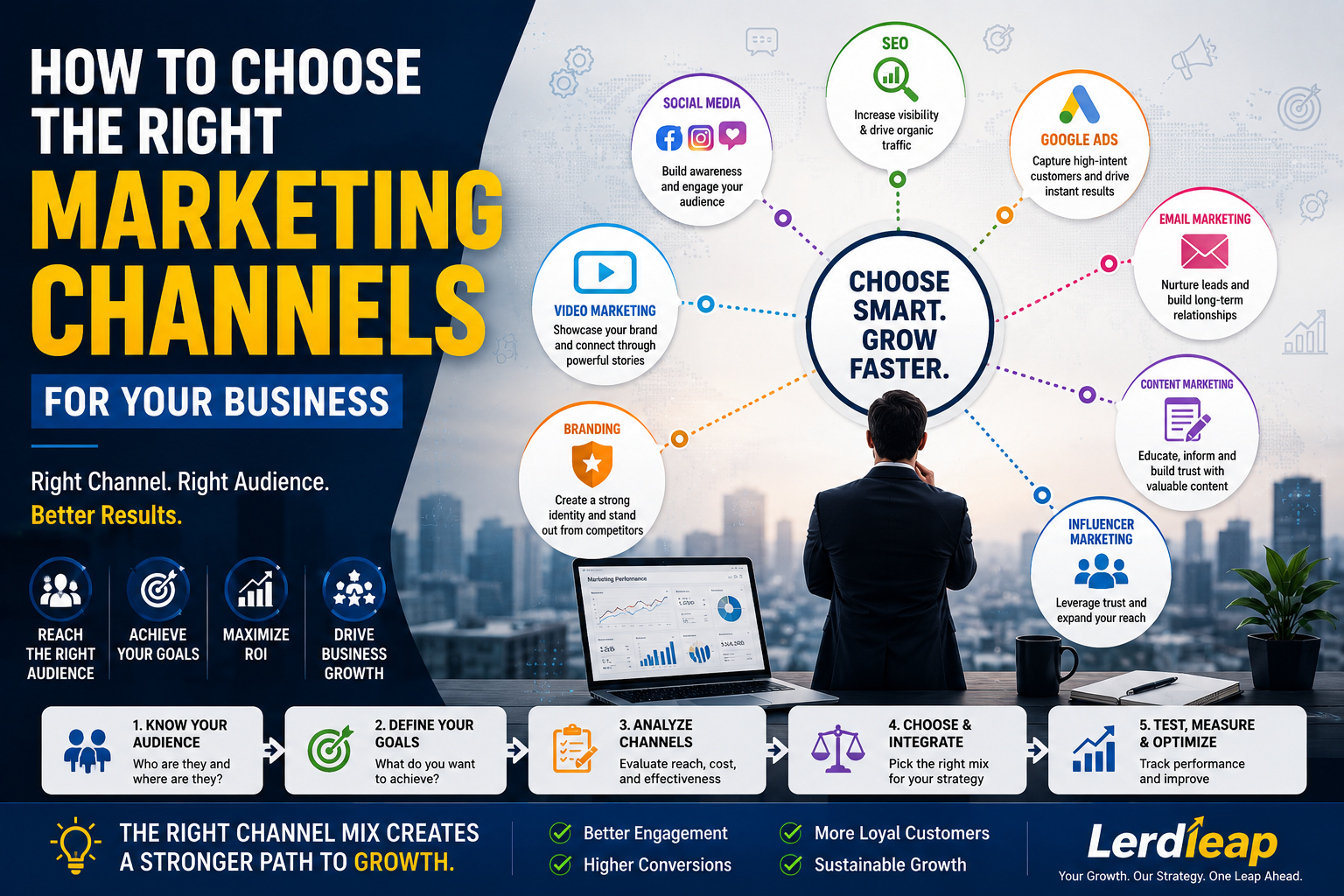

How to Choose the Right Marketing Channels for Your Business
Marketing your business has never offered more options.
You can invest in SEO, social media, Google Ads, video marketing, email campaigns, influencer partnerships, content marketing, print advertising, events, billboards, and many other channels.
But having more options creates another challenge:
Which marketing channels should your business actually use?
Many businesses make the mistake of trying to be everywhere.
They create Instagram posts because competitors are on Instagram. They start running Google Ads because everyone talks about paid search. They launch a YouTube channel, send emails, publish blogs, and experiment with multiple platforms—all without a clear strategy.
The result is often wasted time, money, and effort.
The truth is that you do not need to use every marketing channel.
You need to use the right marketing channels for your business, audience, and goals.
A successful marketing strategy starts by understanding where your customers are, how they make decisions, what resources you have, and which channels can help move potential customers closer to choosing your business.
In this guide, you will learn how to choose the right marketing channels for your business.
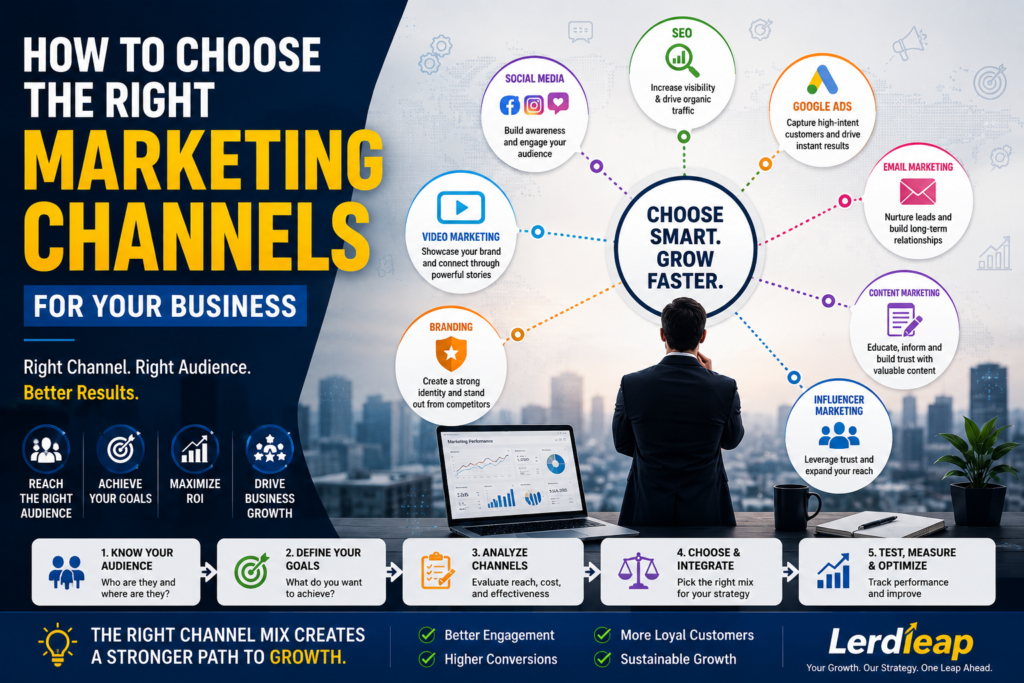
What Are Marketing Channels?
Marketing channels are the platforms and methods businesses use to communicate with potential customers.
They can be divided into several categories.
Digital Marketing Channels
These include:
- Search engine optimization
- Google Ads
- Social media marketing
- Social media advertising
- Content marketing
- Video marketing
- Email marketing
- Influencer marketing
- Display advertising
- Affiliate marketing
- Online communities
Traditional Marketing Channels
These include:
- Television
- Radio
- Newspapers
- Magazines
- Billboards
- Direct mail
- Events
- Print advertising
Owned Marketing Channels
These are channels your business controls directly.
For example:
- Your website
- Your email list
- Your blog
- Your mobile app
- Your customer database
Earned Marketing Channels
These involve other people talking about or sharing your brand.
Examples include:
- Media coverage
- Customer reviews
- Word-of-mouth marketing
- Organic social sharing
- Public relations
The right strategy often combines multiple channels.
However, not every channel deserves equal investment.
Step 1: Start With Your Business Goals
Before choosing a marketing channel, define what you want to achieve.
Different goals require different channels.
Your goal may be to:
- Increase brand awareness
- Generate leads
- Increase website traffic
- Get more sales
- Launch a new product
- Enter a new market
- Build an audience
- Improve customer retention
For example, if your goal is immediate lead generation, channels such as Google Ads, LinkedIn Ads, or targeted social media campaigns may be useful.
If your goal is long-term organic visibility, SEO and content marketing may be more suitable.
If your goal is brand awareness, video, social media, influencer marketing, public relations, or outdoor advertising could be effective.
The important question is:
What do we want this marketing activity to achieve?
Without a clear answer, choosing marketing channels becomes guesswork.
Step 2: Understand Where Your Audience Actually Spends Time
The best marketing channel is not necessarily the most popular one.
It is the channel where your potential customers can be reached effectively.
For example:
A B2B Business
May focus on:
- Google Search
- Email marketing
- Industry events
- Webinars
- SEO
A Fashion Brand
May focus more on:
- Short-form video
- Influencer marketing
- Paid social advertising
A Local Restaurant
May benefit from:
- Google Business visibility
- Local advertising
- Influencer collaborations
- Food delivery platforms
A Real Estate Business
May use:
- Google Search
- YouTube
- Property portals
- Outdoor advertising
- Content marketing
The point is simple:
Your audience should determine your channel strategy.
Do not choose Instagram simply because millions of people use it.
Ask whether your ideal customers use it in a way that supports your business.
Step 3: Understand Your Customer Journey
Customers do not always purchase immediately after discovering your business.
They may go through several stages.
Stage 1: Awareness
The customer discovers that your brand exists.
Useful channels may include:
- Social media
- Video marketing
- SEO
- Influencer marketing
- PR
- Advertising
Stage 2: Consideration
The customer starts researching options.
Useful channels may include:
- Your website
- Blogs
- YouTube videos
- Case studies
- Product comparisons
- Email marketing
Stage 3: Conversion
The customer is ready to take action.
Useful channels may include:
- Google Ads
- Landing pages
- Retargeting
- Email campaigns
- Sales calls
- Offers
Stage 4: Retention
The customer has already purchased.
Useful channels may include:
- Customer support
- Loyalty programs
- Educational content
- Community building
A strong marketing strategy does not focus only on getting attention.
It supports the customer throughout the entire journey.
Step 4: Choose Channels Based on Customer Intent
Not all audiences have the same level of buying intent.
Someone watching an entertaining Instagram Reel may not be ready to buy.
Someone searching Google for:
“best digital marketing agency near me”
may have much stronger purchase intent.
This difference matters.
High-Intent Channels
These may include:
- Google Search
- SEO
- Google Ads
- Review platforms
- Product comparison websites
These channels can help capture people who are actively searching.
Discovery Channels
These may include:
- YouTube
- TikTok
- Influencer marketing
- Display advertising
These channels can help people discover your brand before they begin actively searching.
A strong strategy may use both.
For example:
Social Media → Brand Discovery
↓
Website → Research
↓
Google Search → Comparison
↓
Retargeting → Conversion
Different channels can support different moments in the customer journey.
Step 5: Consider Your Budget and Resources
Some marketing channels require significant investment.
Others require more time than money.
For example:
SEO
Requires:
- Keyword research
- Content creation
- Website optimization
- Consistency
It may take time to produce results, but it can build long-term organic visibility.
Paid Advertising
Can generate traffic quickly.
However, results may stop when spending stops.
Social Media
Can be started with a relatively low financial investment, but consistent content creation requires time and resources.
Video Marketing
Can require:
- Planning
- Scripting
- Production
- Editing
- Distribution
The best marketing strategy is not the most complicated one.
It is the one your business can execute consistently.
Do not build a strategy around ten channels if your team can effectively manage only three.
Step 6: Understand the Strength of Each Marketing Channel
Every channel has advantages and limitations.
SEO
Best for:
- Long-term visibility
- Capturing search demand
- Building authority
- Educational content
Challenge:
Results can take time.
Social Media
Best for:
- Brand awareness
- Community building
- Engagement
- Content distribution
Challenge:
Organic reach and algorithms can change.
Paid Advertising
Best for:
- Faster results
- Targeting
- Lead generation
- Testing offers
Challenge:
Requires budget and ongoing optimization.
Email Marketing
Best for:
- Lead nurturing
- Customer retention
- Repeat sales
- Direct communication
Challenge:
You first need to build a quality audience.
Video Marketing
Best for:
- Brand storytelling
- Education
- Product demonstrations
- Building trust
Challenge:
Requires consistent production.
Content Marketing
Best for:
- Building authority
- Educating customers
- Supporting SEO
- Long-term growth
Challenge:
Requires patience and consistency.
Influencer Marketing
Best for:
- Brand awareness
- Reaching established audiences
- Social proof
Challenge:
The audience and influencer must be a genuine fit.
Step 7: Do Not Choose Channels Based Only on Competitors
Competitor research is useful.
But copying competitors blindly can be a mistake.
Just because your competitor is investing heavily in a particular channel does not mean it is the best choice for your business.
Their:
- Budget
- Target audience
- Business model
- Brand positioning
- Resources
may be completely different.
Instead, study competitors to identify opportunities.
Ask:
- Which channels are they using?
- What content performs well?
- Which customer questions are they answering?
- Where are they not active?
- Is there an opportunity they are missing?
Sometimes the best channel is the one your competitors are ignoring.
Step 8: Start With a Small Number of Channels
One of the biggest marketing mistakes is trying to manage everything at once.
Instead, choose a focused combination.
For example, a service business could start with:
Channel 1: SEO
For long-term organic traffic.
Channel 2: LinkedIn or Instagram
For awareness and relationship building.
Channel 3: Paid Search
For immediate lead generation.
Channel 4: Email
For nurturing potential customers.
This creates a connected system without spreading resources too thin.
Once these channels are working, you can expand.
Step 9: Build an Integrated Marketing System
The best channels work better when connected.
For example:
Content + SEO
Create useful content that can rank and attract search traffic.
Social Media + Content
Use social media to distribute and repurpose your content.
Paid Advertising + Landing Pages
Send targeted traffic to pages designed for conversion.
Email + Content
Use educational content to build trust over time.
Video + Social Media
Turn long-form videos into multiple short-form pieces.
This is more effective than treating every channel as a separate marketing activity.
Think of your marketing as a system.
Each channel should support another.
Step 10: Test Before Making Major Investments
You do not always know which channel will work best until you test it.
Instead of investing your entire budget into one platform, start with controlled experiments.
For example:
Test:
- Different audiences
- Different content formats
- Different advertising messages
- Different offers
- Different landing pages
Then measure the results.
Look at:
- Traffic quality
- Leads
- Conversion rates
- Cost per lead
- Cost per customer
- Customer lifetime value
A channel with the highest number of views may not produce the best business results.
Focus on quality, not just volume.
Step 11: Measure the Right Results
Every marketing channel should have a purpose.
If the goal is brand awareness, measure:
- Reach
- Impressions
- Brand searches
- Audience growth
If the goal is lead generation, measure:
- Leads
- Lead quality
- Cost per lead
- Conversion rate
If the goal is sales, measure:
- Revenue
- Cost per acquisition
- Return on investment
- Customer value
Do not judge every channel using the same metric.
A YouTube video and a Google Search campaign may play completely different roles.
One may create awareness.
The other may capture existing demand.
Both can be valuable.
A Simple Marketing Channel Selection Framework
Before choosing a marketing channel, ask these five questions:
1. Where is our audience?
Find the platforms, websites, communities, and environments where your customers spend time.
2. What is our goal?
Are you trying to create awareness, generate leads, or increase sales?
3. What stage is the customer in?
Are they discovering the problem, researching solutions, or ready to buy?
4. What resources do we have?
Consider your budget, team, skills, and time.
5. How will we measure success?
Define the metrics before launching the campaign.
This simple framework can prevent a significant amount of wasted marketing effort.
Example: Choosing Marketing Channels for a Small Business
Imagine a growing service-based business.
Its goals are:
- Generate more qualified leads
- Build brand awareness
- Create long-term growth
A possible channel strategy could be:
SEO and Blogs
Answer customer questions and build organic visibility.
Google Ads
Capture high-intent customers searching for the service.
Instagram or LinkedIn
Build brand awareness and demonstrate expertise.
Email Marketing
Nurture leads who are not ready to purchase immediately.
Video Content
Build trust and explain services.
Instead of relying on one channel, each platform plays a specific role.
That is what makes the strategy more effective.
Common Mistakes When Choosing Marketing Channels
Avoid these mistakes.
Trying to Be Everywhere
More channels do not automatically mean more customers.
Following Trends Without Strategy
A popular platform may not be relevant to your audience.
Ignoring Your Website
Even the best marketing campaign can fail if the website experience is poor.
Focusing Only on New Customers
Retention channels can be just as important as acquisition.
Expecting Instant Results From Every Channel
SEO, content, and brand building often require time.
Measuring Only Vanity Metrics
Views and likes do not always equal business growth.
Final Thoughts: Choose the Channels That Support Your Business Goals
There is no universal list of the best marketing channels.
The best channel for one business may be completely ineffective for another.
Your strategy should be based on:
Your Audience + Your Goals + Customer Intent + Budget + Resources + Measurement
Start with a few channels.
Understand what role each one plays.
Create a connected customer journey.
Test your approach.
Measure the results.
Then invest more heavily in the channels that contribute to meaningful business growth.
The goal is not to be everywhere.
The goal is to be in the right places, with the right message, at the right stage of the customer journey.
That is how you choose the right marketing channels for your business.
Take Your Brand Further with Lerdleap
At Lerdleap, we help businesses identify the right marketing channels and connect them into one clear growth strategy. From SEO and content marketing to video, social media, branding, paid advertising, and performance marketing, we focus on building strategies around your business goals and the people you want to reach.
Ready to stop guessing where to market your business? Lerdleap can help you build a strategy where every channel has a purpose.