
Every business owner in Hyderabad eventually reaches the same crossroads.
Should we invest in SEO or spend our budget on Performance Marketing?
The answer isn’t as straightforward as choosing one over the other.
One promises immediate leads.
The other builds a business asset that compounds over time.
Many agencies simplify the discussion by claiming SEO is “better” or that paid advertising delivers “instant results.” In reality, the right strategy depends on your business stage, competition, customer buying journey, and long-term revenue goals.
In 2026, this decision has become even more important because the digital landscape is changing rapidly.
Google’s AI-powered search experience, evolving customer behavior, rising advertising costs, and increasing competition mean businesses must invest in marketing channels that create sustainable growth rather than short-lived spikes in traffic.
Whether you’re a healthcare provider, real estate developer, educational institute, manufacturing company, SaaS startup, or local service business in Hyderabad, understanding the strengths and limitations of both SEO and Performance Marketing can significantly impact your marketing ROI.
This guide explores both approaches in depth, helping you determine which delivers stronger long-term business growth—and when combining them creates the greatest competitive advantage.
Hyderabad’s Digital Economy Is Growing Faster Than Ever
Hyderabad has evolved far beyond being an IT hub. Today, it is home to rapidly expanding industries, including:
- Healthcare and multi-specialty hospitals
- Real estate and infrastructure
- Educational institutions and EdTech
- Manufacturing and industrial businesses
- D2C brands and eCommerce
- Financial services
- Software and SaaS companies
- Professional consulting firms
Across these sectors, one trend is clear: buyers are researching extensively online before making purchasing decisions.
People no longer rely solely on advertisements. They compare providers, read reviews, watch videos, browse websites, and seek trustworthy information before reaching out.
This shift means businesses need visibility throughout the customer’s decision-making journey—not just when an ad appears.
The Modern Customer Journey Has Changed
Five years ago, a customer might click the first advertisement they saw.
Today, the buying process is significantly more complex.
Consider someone searching for a cosmetic clinic in Hyderabad.
Their journey might look like this:
- Search for treatment information.
- Read educational blog articles.
- Watch YouTube videos.
- Compare clinics.
- Check Google reviews.
- Visit Instagram.
- Search again.
- Read FAQs.
- Compare pricing.
- Finally book an appointment.
Only one of these steps may involve a paid advertisement.
The remaining interactions depend heavily on organic visibility, helpful content, credibility, and trust.
This is why businesses focused solely on advertising often struggle to maintain consistent growth once ad spending decreases.
Understanding SEO Beyond Rankings
Many people define SEO simply as “ranking on Google.”
That definition is outdated.
Modern SEO is about becoming the most trusted answer to a customer’s question.
When someone searches:
- “Best dental implant clinic Hyderabad”
- “Luxury apartments near Financial District”
- “Data Science course Hyderabad”
- “Digital marketing agency Hyderabad”
Google evaluates hundreds of signals before deciding which businesses deserve visibility.
Google regularly updates its guidance to help businesses create useful, people-first content. Reviewing the Google Search Essentials can help you understand the core principles behind sustainable organic visibility.
Effective SEO now includes:
Want to understand how SEO works for local businesses? Read our comprehensive guide on Digital Marketing Company in Hyderabad, where we explain how SEO, local search, Google Business Profile optimization, and content marketing work together to generate qualified leads.
Technical SEO
A fast, mobile-friendly, secure website that search engines can crawl efficiently.
Content Strategy
Publishing genuinely helpful articles, guides, case studies, FAQs, videos, and service pages that solve user problems.
Local SEO
Optimizing your Google Business Profile, local citations, reviews, maps visibility, and location-specific content.
Authority Building
Earning backlinks, mentions, digital PR, and demonstrating expertise through high-quality content.
User Experience
Ensuring visitors can easily navigate your site, find information, and complete desired actions.
SEO is no longer a standalone tactic. It is a comprehensive strategy that strengthens your digital presence across multiple touchpoints.
What Is Performance Marketing?
Performance Marketing refers to digital advertising where businesses pay for measurable outcomes such as:
- Website visits
- Leads
- Phone calls
- Purchases
- App installs
- Form submissions
Common platforms include:
- Google Ads
- Meta Ads (Facebook & Instagram)
- LinkedIn Ads
- YouTube Ads
- Microsoft Ads
- Display Networks
- Remarketing Campaigns
If you’re evaluating paid campaigns, our detailed guide on Lead Generation Cost in Hyderabad explains the factors affecting advertising budgets, cost per lead, and how businesses can improve marketing ROI.
Unlike SEO, which takes time to build momentum, Performance Marketing can start generating traffic almost immediately after campaigns launch.
This makes it particularly valuable for businesses needing:
- Immediate inquiries
- Product launches
- Seasonal promotions
- Event registrations
- New business visibility
- Rapid market testing
However, the traffic typically stops once advertising budgets are paused.
The Biggest Misconception Businesses Have
One of the most common misconceptions is viewing SEO and Performance Marketing as competing strategies.
In reality, they serve different purposes.
Think of them as two engines powering the same aircraft.
Performance Marketing accelerates takeoff.
SEO keeps the aircraft flying efficiently over long distances.
Businesses that rely exclusively on paid advertising often face increasing acquisition costs over time.
Conversely, businesses relying only on SEO may miss immediate revenue opportunities during the early stages of growth.
The strongest marketing strategies recognize the complementary nature of both approaches.
Introducing the Growth Asset Framework™
One practical way to evaluate marketing investments is by distinguishing between renting attention and building an asset.
We call this the Growth Asset Framework™.
Performance Marketing: Renting Attention
Each click is purchased.
Once the campaign ends:
- Traffic declines.
- Lead generation slows.
- Visibility disappears.
- Revenue often drops unless spending resumes.
Performance Marketing functions much like renting a premium retail space. It delivers immediate exposure, but only while you continue paying.
SEO: Building a Business Asset
SEO creates long-term value through:
- Evergreen content
- Strong domain authority
- Organic rankings
- Brand recognition
- Repeat website visitors
- Sustainable lead generation
Each well-optimized article, landing page, and service page becomes a digital asset that can continue attracting qualified prospects long after it is published.
Unlike paid campaigns, these assets often appreciate over time as they gain authority, backlinks, and user engagement.
Why This Matters More in 2026
Marketing costs are increasing across nearly every advertising platform.
Businesses are experiencing:
- Higher Cost Per Click (CPC)
- Greater competition
- Rising Cost Per Acquisition (CPA)
- Increased demand for quality content
- More informed customers
- AI-powered search experiences that reward authoritative websites
As acquisition costs continue to climb, companies that invest in long-term organic visibility reduce their dependence on continuously increasing advertising budgets.
The question is no longer:
“Should we invest in SEO or Performance Marketing?”
The better question is:
“How should we balance immediate lead generation with sustainable business growth?”
That distinction separates businesses chasing short-term wins from those building enduring digital brands.
SEO vs Performance Marketing: Which Generates Higher ROI?
One of the biggest mistakes business owners make is comparing SEO and Performance Marketing based only on how many leads they generate.
A smarter comparison looks at:
- Cost per lead
- Quality of leads
- Customer lifetime value (LTV)
- Brand trust
- Scalability
- Sustainability
- Return on investment over time
The real question isn’t:
“Which channel brings more leads today?”
It’s:
“Which channel helps my business grow profitably over the next three years?”
Let’s break it down.
The Business Growth Timeline
Every marketing investment performs differently over time.
Think of SEO and Performance Marketing as two investment portfolios.
Performance Marketing
Month 1
- Traffic starts immediately
- Leads begin arriving
- Sales can happen within days
Month 2–6
- Campaign optimization improves conversions.
- More budget generally means more traffic.
Year 1
Growth continues—but only if advertising spend remains consistent.
Pause the campaigns?
Traffic declines almost instantly.
SEO
Month 1
- Website optimization
- Content planning
- Technical improvements
Traffic growth is often limited.
Month 3
Some pages begin appearing on Google.
Organic impressions increase.
Long-tail keywords start generating visitors.
Month 6
Authority grows.
More keywords rank.
Qualified traffic increases.
Lead generation becomes more consistent.
Year 1
The website has become a valuable marketing asset.
Existing content continues attracting visitors.
New pages rank faster because the domain has gained authority.
Year 3
A mature SEO strategy often generates leads daily without requiring payment for every click.
This is where SEO begins outperforming many paid acquisition strategies in terms of cumulative ROI.
Understanding Marketing Through an Investment Lens
Imagine you invest ₹5 lakh over one year.
Scenario A
You invest entirely in Google Ads.
Results:
- Immediate visibility
- Immediate leads
- Immediate sales
But after twelve months, you stop advertising.
What happens?
Traffic disappears.
Leads stop.
Sales slow down.
Your investment produced revenue—but not a lasting asset.
Scenario B
You invest the same ₹5 lakh into SEO.
You build:
- Service pages
- Location pages
- Blog content
- Technical improvements
- Local SEO
- Digital authority
At the end of the year:
Your website has become stronger.
It ranks for hundreds of search queries.
It continues generating visitors without paying for every click.
That investment keeps producing returns.
The Hidden Cost Businesses Ignore
Most companies calculate:
Advertising Cost
But they rarely calculate:
Cost of Dependency
Businesses dependent solely on paid advertising face several challenges:
- Rising CPC every year
- Increasing competition
- Platform algorithm changes
- Campaign fatigue
- Reduced profitability
This creates a cycle where businesses must continuously spend more simply to maintain the same lead volume.
SEO reduces that dependency.
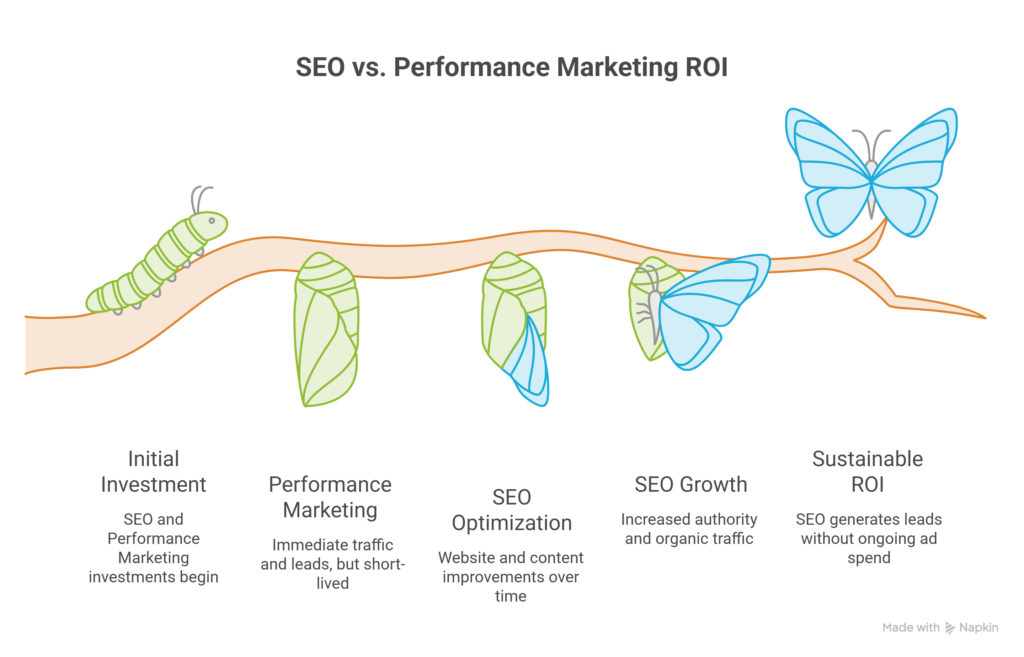
SEO vs Performance Marketing Across Key Business Metrics
| Factor | SEO | Performance Marketing |
|---|---|---|
| Traffic Speed | Slow initially | Immediate |
| Long-Term ROI | Excellent | Moderate |
| Brand Authority | High | Limited |
| Customer Trust | High | Medium |
| Lead Cost Over Time | Decreases | Often increases |
| Scalability | Excellent | Budget-dependent |
| Visibility Duration | Long-term | Ends with budget |
| Business Asset Creation | Yes | No |
| Predictability | Improves over time | Depends on platform performance |
Which Delivers Better Lead Quality?
Lead quantity and lead quality are very different.
Imagine someone searches:
“Digital marketing agency for hospitals in Hyderabad”
This search indicates strong intent.
The user already understands the problem.
They’re actively looking for a solution.
Organic visitors arriving through detailed educational content often spend more time researching before contacting a business.
That usually means:
- Higher trust
- Better conversion rates
- Lower objections during sales
- Higher customer lifetime value
Meanwhile, Performance Marketing often captures users who may still be comparing multiple options after clicking an advertisement.
This doesn’t mean paid leads are low quality.
Rather, they frequently require more nurturing before converting.
Trust: The Invisible Conversion Factor
Google users subconsciously trust businesses appearing organically.
Why?
Because they believe Google has ranked those businesses based on relevance and quality—not simply because they paid for placement.
Consider your own behavior.
When searching for a significant purchase, do you click only advertisements?
Most people don’t.
They often scroll to the organic results, compare websites, read reviews, and consume helpful content before making a decision.
That trust translates into stronger conversion rates over time.
Customer Acquisition Cost Over Five Years
Imagine two businesses beginning with identical marketing budgets.
Company Alpha
Relies entirely on paid advertising.
Each year:
- CPC increases.
- Competition intensifies.
- Cost per lead rises.
Marketing expenses continue growing.
Company Beta
Invests in SEO.
Year after year:
- More pages rank.
- Domain authority improves.
- Organic traffic compounds.
- Brand searches increase.
Eventually, the company spends less per acquired customer because organic traffic contributes a larger share of leads.
This compounding effect is one of SEO’s greatest advantages.
The Compounding Growth Curve
SEO behaves much like compound interest.
Each optimized page strengthens your website.
Each quality backlink increases authority.
Each satisfied visitor contributes positive engagement signals.
Each case study enhances credibility.
Each blog expands keyword visibility.
These improvements reinforce one another.
Over time, growth accelerates.
Performance Marketing, by contrast, is more linear.
More budget typically produces more clicks.
Less budget produces fewer clicks.
Industry-Wise Comparison
Not every industry should allocate its marketing budget the same way.
Let’s examine how different sectors benefit from SEO and Performance Marketing.
Healthcare
Patients research extensively before selecting:
- Hospitals
- Clinics
- Specialists
- Diagnostic centers
They compare:
- Reviews
- Expertise
- Treatment options
- Pricing
- Patient experiences
Educational content plays a crucial role in earning trust.
Recommendation
70% SEO
30% Performance Marketing
Real Estate
Property buyers spend weeks or months researching.
They explore:
- Localities
- Builder reputation
- Amenities
- Pricing
- Investment potential
SEO helps capture prospects during the research phase, while Performance Marketing excels at promoting launches and generating immediate inquiries.
Recommendation
60% SEO
40% Performance Marketing
Educational Institutions
Students rarely enroll after seeing a single advertisement.
They research:
- Courses
- Placement records
- Faculty
- Reviews
- Fees
- Career opportunities
SEO enables institutions to answer these questions with in-depth content, attracting qualified prospects throughout the decision process.
Recommendation
65% SEO
35% Performance Marketing
SaaS Companies
Software buyers often search for:
- Comparisons
- Integrations
- Use cases
- Tutorials
- Pricing
High-quality SEO content supports each stage of the buyer journey, while paid campaigns are effective for product launches and retargeting.
Recommendation
55% SEO
45% Performance Marketing
Local Service Businesses
Examples include:
- Interior designers
- Architects
- Law firms
- Accounting firms
- Home renovation companies
For these businesses, Local SEO is often one of the highest-return marketing investments because customers search with strong purchase intent.
Recommendation
70% SEO
30% Performance Marketing
A Practical Decision Matrix
Use these questions to guide your strategy:
- Do you need leads within the next 30 days? Lean more on Performance Marketing.
- Are you building a brand for the next five years? Invest heavily in SEO.
- Is your industry highly competitive? Combine both for balanced growth.
- Are advertising costs becoming difficult to sustain? Strengthen your SEO foundation.
- Do customers spend time researching before buying? Prioritize educational content and organic visibility.
The strongest businesses rarely choose one channel exclusively. They use Performance Marketing to generate immediate demand while SEO steadily builds a durable, lower-cost acquisition engine.
The Future of Business Growth — Why SEO and Performance Marketing Work Better Together
Most discussions around SEO and Performance Marketing end with a simple conclusion:
“Use both.”
While that’s technically correct, it doesn’t answer the real question:
How should businesses combine them to maximize long-term growth?
The answer depends on where your business is today—not where you want it to be.
The Business Growth Pyramid™
Instead of choosing one channel over the other, think about marketing as a pyramid.
Level 1: Build a Strong Foundation
Before spending heavily on marketing, ensure your digital assets are in place:
- A fast, mobile-friendly website
- Clear service pages
- Trust-building elements (reviews, certifications, case studies)
- Conversion-focused landing pages
- Technical SEO
- Local SEO optimization
- Analytics and conversion tracking
Without this foundation, even the best ad campaigns will underperform.
Level 2: Create Valuable Content
This is where SEO begins to generate long-term value.
Develop content that answers real customer questions, such as:
- Buying guides
- Cost comparisons
- Service comparisons
- Industry trends
- FAQs
- Case studies
- Location-specific pages
- Problem-solving blogs
Every quality page expands your website’s reach and authority.
Level 3: Accelerate with Performance Marketing
Once your website can effectively convert visitors, paid advertising becomes significantly more efficient.
Instead of sending traffic to a basic landing page, you’re directing users to a website that already demonstrates expertise and trust.
This often improves:
- Conversion rates
- Quality Score (for Google Ads)
- Cost per acquisition
- Return on ad spend (ROAS)
Google’s Search Has Changed Forever
Ranking on Google is no longer just about appearing as the first blue link.
Today’s search results may include:
- AI Overviews
- Featured snippets
- Local Map Pack
- Videos
- Images
- People Also Ask
- Reviews
- Product listings
- Discussion forums
A single search can display multiple content formats before users even reach traditional organic listings.
This means businesses need a broader content strategy that goes beyond optimizing one service page.
AI Is Changing SEO—But Not Replacing It
With the rise of AI-powered search experiences, some businesses assume SEO is becoming less important.
In reality, AI increases the importance of trustworthy, well-structured, and experience-based content.
AI systems summarize information from authoritative sources. If your website consistently publishes original insights, case studies, and practical expertise, it has a greater chance of influencing those summaries and attracting users who want more detailed information.
Generic, repetitive content is less likely to stand out.
Why Generic SEO Content No Longer Works
Many websites still publish articles like:
- “10 Benefits of Digital Marketing”
- “What Is SEO?”
- “Importance of Social Media”
These topics have been covered thousands of times.
To earn attention in 2026, your content needs to answer questions more deeply, more clearly, or from a unique perspective.
Examples include:
- Original frameworks for evaluating marketing ROI
- Local market insights specific to Hyderabad
- Industry-specific case studies
- Real budgeting scenarios
- Step-by-step implementation guides
- Decision-making tools and checklists
Content that helps users make better decisions is more likely to earn engagement, backlinks, and long-term visibility.
Common Mistakes Hyderabad Businesses Make
1. Treating SEO as a One-Time Project
SEO is an ongoing process. Search trends, competitors, and customer behavior evolve constantly.
Publishing a few pages and expecting permanent rankings is unrealistic.
2. Measuring Success Too Early
It’s common to evaluate SEO after one or two months.
Organic growth typically builds gradually. Looking only at short-term results can lead to abandoning a strategy before it has time to mature.
3. Chasing Cheap Leads
A lower cost per lead doesn’t always mean better business outcomes.
A smaller number of highly qualified leads can produce more revenue than a large volume of unqualified inquiries.
4. Ignoring Local SEO
Many businesses invest in ads while overlooking opportunities to appear in local searches.
Optimizing your Google Business Profile, collecting reviews, and creating location-focused content can significantly improve visibility for nearby customers.
5. Producing Content for Search Engines Instead of People
Search engines increasingly reward content that demonstrates experience, expertise, and usefulness.
Writing for real people first—and optimizing second—creates a better user experience and stronger long-term results.
A Balanced Marketing Budget Framework
The ideal mix depends on your stage of growth.
New Business (0–12 Months)
Focus on building visibility quickly while laying the groundwork for organic growth.
- SEO: 40%
- Performance Marketing: 60%
Growing Business (1–3 Years)
Expand your content library, strengthen authority, and reduce reliance on paid traffic.
- SEO: 60%
- Performance Marketing: 40%
Established Business (3+ Years)
Use SEO as your primary acquisition engine, with paid campaigns supporting launches, promotions, and remarketing.
- SEO: 70%
- Performance Marketing: 30%
These ratios are starting points rather than fixed rules. Businesses with seasonal demand or aggressive expansion plans may choose different allocations.
Which Businesses Benefit Most from SEO?
SEO is particularly effective for businesses where customers research before making a decision, including:
- Hospitals and clinics
- Educational institutions
- Real estate developers
- SaaS companies
- Law firms
- Financial consultants
- Manufacturing companies
- B2B service providers
- Interior designers
- Architects
In these industries, visibility during the research phase can influence purchasing decisions long before a customer contacts your business.
Which Businesses Should Prioritize Performance Marketing?
Performance Marketing is often well suited for:
- Product launches
- Limited-time offers
- Seasonal campaigns
- Event registrations
- E-commerce promotions
- Inventory clearance
- New market entry
- Brand awareness campaigns
Its strength lies in generating immediate visibility and measurable results.
Final Thoughts
Choosing between SEO and Performance Marketing isn’t about picking a winner.
It’s about understanding what each channel is designed to achieve.
Performance Marketing can help you generate visibility, test offers, and acquire customers quickly.
SEO helps you build authority, trust, and a marketing asset that continues working long after it’s created.
The businesses that achieve consistent digital growth usually don’t depend on a single channel. They invest in immediate opportunities while steadily strengthening their organic presence.
As search behavior evolves and AI-powered experiences become more common, businesses that publish genuinely helpful, experience-driven content and maintain a strong technical foundation will be better positioned to earn attention and trust.
Conclusion
If your goal is fast results, Performance Marketing is an effective way to generate immediate traffic and leads.
If your goal is lasting business growth, SEO is a strategic investment that compounds over time through stronger visibility, authority, and lower long-term acquisition costs.
For many Hyderabad businesses, the most resilient strategy is to combine both:
- Use Performance Marketing to capture immediate demand.
- Use SEO to build a long-term growth engine.
- Measure results continuously and adjust your investment based on business goals, market conditions, and customer behavior.
When these channels support each other instead of competing, they create a more sustainable path to growth than either approach can achieve alone.