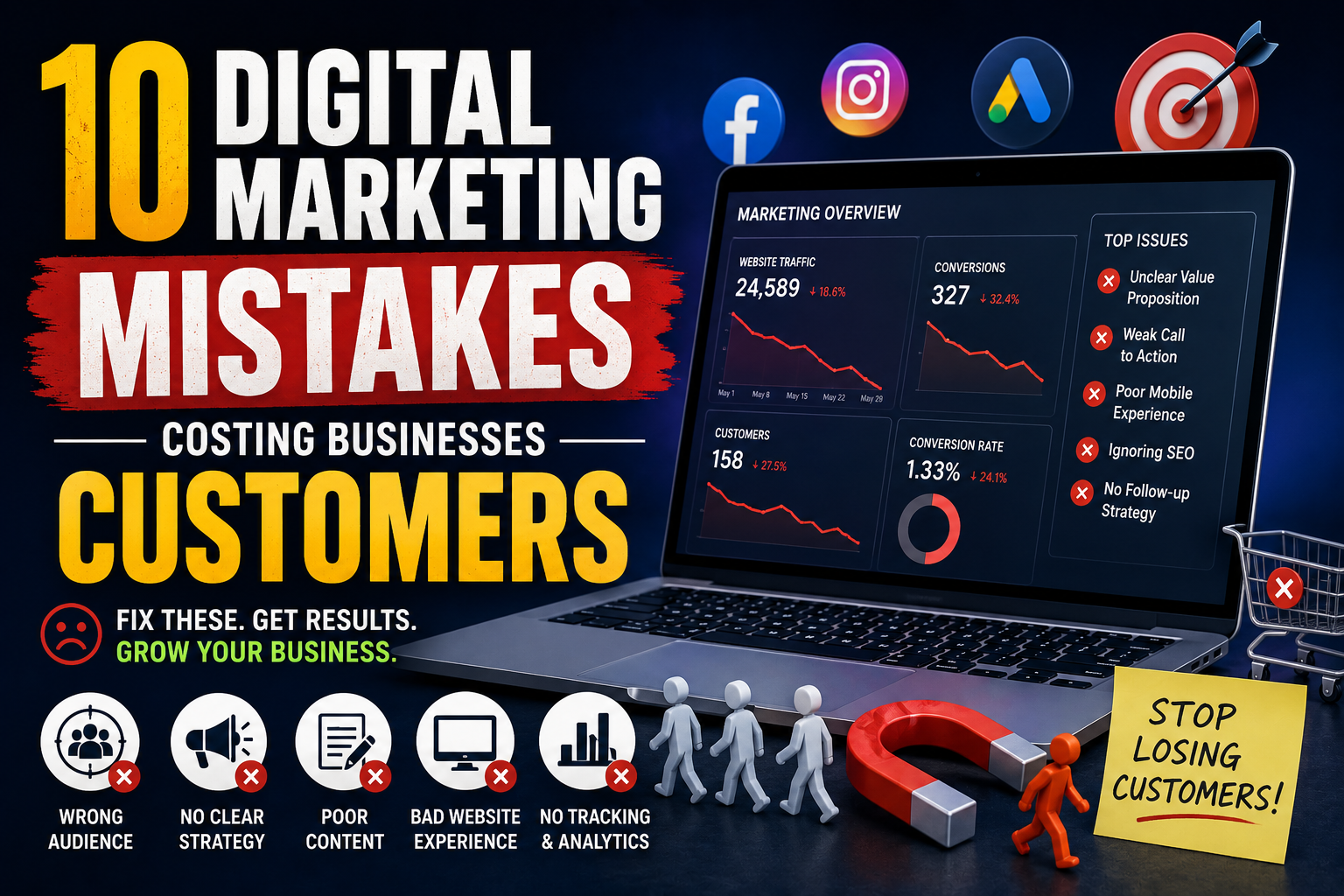

10 Digital Marketing Mistakes Costing Businesses Customers
Digital marketing gives businesses more opportunities than ever to reach potential customers.
You can run ads, create content, rank on search engines, build an email list, engage audiences on social media, and track customer behaviour across multiple channels.
But having access to all these tools does not automatically create results.
In fact, many businesses are spending money on digital marketing while unknowingly making mistakes that reduce traffic, waste advertising budgets, weaken customer trust, and ultimately cost them potential customers.
The problem is that these mistakes are often not obvious.
A business may believe that its marketing is not working because of low budgets, increased competition, or changing algorithms. However, the real problem may be something much simpler: the website is difficult to use, the messaging is unclear, the ads target the wrong audience, or the business is attracting visitors without giving them a clear reason to take action.
The good news?
Most digital marketing mistakes can be fixed.
Here are 10 digital marketing mistakes costing businesses customers—and what you can do about them.
1. Not Understanding Your Target Audience
One of the biggest digital marketing mistakes is trying to speak to everyone.
When your message is designed for everyone, it often connects deeply with no one.
Many businesses begin with questions like:
- What should we post on Instagram?
- Should we run Google Ads?
- How often should we publish blogs?
These are useful questions, but they come after a more important one:
Who exactly are we trying to reach?
Before creating content or launching campaigns, you need to understand your target audience.
Ask:
- Who is your ideal customer?
- What problem are they trying to solve?
- What frustrates them?
- What questions do they ask before buying?
- What motivates their decision?
- What objections stop them from purchasing?
- Where do they spend time online?
For example, a luxury real estate brand and a budget-friendly housing platform may both target people looking for property.
But their customers have completely different motivations.
One may care about exclusivity, investment potential, location, and lifestyle.
The other may care more about affordability, financing, and practical information.
The marketing message should reflect those differences.
How to fix it
Create clear customer profiles before planning your campaigns.
You do not need dozens of complicated documents. Start with a simple understanding of:
Audience + Problem + Motivation + Objection + Desired Outcome
The better you understand your customer, the easier it becomes to create content, advertisements, and offers that actually get their attention.
2. Focusing on Selling Instead of Providing Value
Another common mistake is turning every piece of content into a sales pitch.
Businesses often post:
- Buy now
- Contact us
- Limited offer
- Best service
- Best quality
- Call today
There is nothing wrong with selling.
The problem is that customers usually do not want to see advertisements every time they interact with your brand.
Modern digital marketing works best when brands create value before asking for attention or action.
Your content should answer questions, solve problems, educate customers, or provide useful insights.
For example, instead of constantly posting:
“We offer the best digital marketing services.”
You could create content such as:
- 5 reasons your ads are not converting
- How to improve website conversions
- Common SEO mistakes businesses make
- How to choose the right marketing channel
- What customers expect from brands in 2026
This type of content demonstrates expertise.
And expertise builds trust.
How to fix it
Use a balanced content strategy.
A simple approach is to create content around:
- Education – Teach your audience something useful.
- Trust – Show results, testimonials, case studies, and expertise.
- Engagement – Create conversations and relatable content.
- Conversion – Promote your product or service.
Not every post needs to sell.
But your overall content strategy should eventually guide the right audience toward becoming customers.
3. Having a Website That Does Not Convert
Getting traffic is only half the job.
If people visit your website and immediately leave, your marketing budget is being wasted.
Many businesses focus heavily on generating traffic but pay very little attention to what happens after a visitor arrives.
Common website problems include:
- Slow loading speed
- Confusing navigation
- Too much text
- Poor mobile experience
- Weak headlines
- Unclear offers
- No visible call to action
- Complicated forms
- Outdated design
Imagine spending thousands on advertising to bring 10,000 visitors to your website.
If the website does not clearly explain what you offer, many of those visitors may leave without taking action.
That means the problem is not necessarily your advertising.
It may be your conversion experience.
How to fix it
Review your website from the customer’s perspective.
Within the first few seconds, a visitor should understand:
- What you offer
- Who it is for
- Why it matters
- What they should do next
Your calls to action should also be clear.
Instead of vague buttons such as:
Learn More
consider more specific actions such as:
- Get Your Free Consultation
- Explore Our Services
- Request a Quote
- Book a Demo
- Talk to an Expert
Clarity reduces friction.
And reducing friction can improve conversions.
4. Ignoring Mobile Users
A large percentage of your audience is likely discovering your business through a smartphone.
They may see your:
- Instagram post
- Google search result
- YouTube video
- Advertisement
- Website
directly from a mobile device.
Yet many businesses still create marketing experiences primarily for desktop users.
This can cause major problems.
A website may look perfect on a laptop but become difficult to navigate on a smartphone.
Buttons may be too small.
Forms may be frustrating.
Images may take too long to load.
Text may be difficult to read.
If the customer experience is poor, people will simply leave.
How to fix it
Think mobile first.
Before launching any campaign, test:
- Landing pages
- Contact forms
- Checkout processes
- Website navigation
- Email design
- Call-to-action buttons
Open everything on an actual smartphone.
Do not assume that a responsive website automatically provides a good mobile experience.
Ask:
Can a customer easily understand, navigate, and take action within a few seconds?
If the answer is no, fix that before spending more money to drive traffic.
5. Using the Same Content on Every Platform
Copying and pasting the exact same content everywhere is one of the most common marketing mistakes.
Every platform has different user behaviour.
A long LinkedIn post may not work as an Instagram Reel.
A YouTube video may need to be transformed before becoming a short-form video.
An email newsletter should not simply be a copy of a social media caption.
The core idea can remain the same.
But the format should change.
For example, one topic could become:
Blog
10 Digital Marketing Mistakes Businesses Make
YouTube Video
The 10 Marketing Mistakes Killing Your Growth
Instagram Reel
Your Website Is Getting Traffic but No Customers? Here’s Why.
LinkedIn Post
Most businesses don’t have a traffic problem. They have a conversion problem.
Are These Marketing Mistakes Costing You Customers?
One idea.
Multiple formats.
Different experiences.
How to fix it
Create content with a repurposing strategy.
Start with one strong topic and adapt it for each platform instead of creating unrelated content every day.
This improves consistency while making content production more efficient.
6. Ignoring SEO and Organic Search
Some businesses rely entirely on paid advertising.
The moment they stop spending, the traffic disappears.
Paid advertising can be extremely valuable.
But depending completely on it creates risk.
SEO and content marketing can help businesses build long-term visibility.
When potential customers search for questions related to your industry, your business should have useful content that answers them.
For example, a digital marketing company could create content around:
- How much does digital marketing cost?
- How do Google Ads work?
- What is SEO?
- How long does SEO take?
- Why is my website not ranking?
A real estate business could target:
- Best areas to invest in
- Apartment buying mistakes
- Real estate market trends
- Home loan guides
- Property investment tips
This content can continue attracting relevant visitors long after it is published.
How to fix it
Build a keyword strategy around customer questions and search intent.
Focus on:
- Informational keywords
- Commercial keywords
- Comparison keywords
- Problem-solving searches
- Location-based searches
Do not create content just to publish more blogs.
Create content because it answers something your potential customer is already looking for.
7. Running Ads Without a Clear Strategy
Running advertisements is easy.
Running profitable advertisements is more difficult.
Many businesses make the mistake of launching ads without clearly defining:
- The target audience
- The campaign objective
- The offer
- The landing page
- The conversion goal
- The measurement strategy
As a result, they may receive:
- Clicks but no leads
- Leads but poor-quality prospects
- Views but no sales
- Traffic but no engagement
Advertising should be connected to a business objective.
For example:
Awareness Campaign
Goal: Reach new potential customers.
Lead Generation Campaign
Goal: Collect qualified enquiries.
Sales Campaign
Goal: Generate purchases.
Retargeting Campaign
Goal: Reconnect with people who already know the brand.
Each campaign requires a different approach.
How to fix it
Before spending money, define:
Audience → Message → Offer → Landing Page → Call to Action → Measurement
If any of these elements are weak, the entire campaign may struggle.
8. Not Tracking What Actually Works
Another expensive mistake is making marketing decisions based entirely on assumptions.
Businesses may say:
- Instagram is working.
- Google Ads are expensive.
- Our blog gets traffic.
- Facebook does not work anymore.
But what does the data actually say?
You need to understand which activities are contributing to real business results.
Important metrics may include:
- Website traffic
- Conversion rate
- Cost per lead
- Cost per acquisition
- Lead quality
- Customer lifetime value
- Organic traffic
- Engagement rate
- Revenue by channel
Not every metric deserves equal attention.
For example, 100,000 views may look impressive.
But if those views produce zero relevant leads or customers, the business impact may be limited.
Meanwhile, a campaign with only 5,000 highly targeted views could generate significant revenue.
How to fix it
Focus on metrics connected to your business objective.
Do not ask only:
How many people saw this?
Also ask:
What happened after they saw it?
9. Being Inconsistent With Content and Branding
Many businesses start digital marketing with enthusiasm.
They publish every day for two weeks.
Then disappear for a month.
Then launch another campaign.
Then stop again.
This creates an inconsistent brand experience.
Consistency matters because customers often need multiple interactions before they remember and trust a brand.
Your audience should gradually begin to recognize:
- Your visual identity
- Your tone of voice
- Your expertise
- Your content style
- Your point of view
Consistency does not mean posting every hour.
It means creating a sustainable system.
How to fix it
Create a realistic content schedule.
For example:
- 2 blogs per month
- 2 videos per week
- 3 social media posts per week
- 1 email newsletter per week
The exact numbers will depend on your resources.
The important thing is to create a system you can maintain.
A consistent strategy is usually more valuable than an intense strategy that disappears after one month.
10. Forgetting the Customer Journey After the First Click
Getting someone to click your ad is not the end of marketing.
It is the beginning of a customer journey.
A potential customer may:
- Discover your brand on social media.
- Visit your website.
- Leave without purchasing.
- Search for your brand later.
- Read reviews.
- Compare competitors.
- Return after several days.
- Finally make a decision.
If your marketing strategy only focuses on the first click, you may lose customers who need more time and information before buying.
This is particularly important for:
- High-value services
- Real estate
- B2B businesses
- Financial products
- Technology solutions
- Education
- Healthcare services
Customers may require multiple touchpoints.
How to fix it
Create content and campaigns for different stages of the customer journey.
Awareness
Help people discover the brand.
Use:
- Social media
- SEO
- Video
- Educational content
Consideration
Help people evaluate the solution.
Use:
- Case studies
- Comparisons
- Testimonials
- Product demonstrations
Conversion
Help people take action.
Use:
- Offers
- Consultations
- Free trials
- Clear calls to action
Retention
Keep existing customers engaged.
Use:
- Customer education
- Support content
- Exclusive offers
The strongest marketing systems do not simply generate clicks.
They guide customers through a complete journey.
How to Avoid These Digital Marketing Mistakes
The solution is not to use every marketing platform.
You do not need to be everywhere.
Instead, build a strategy around your business goals.
Start with these five questions:
1. Who is our ideal customer?
Understand the audience before creating content.
2. What problem do we solve?
Your marketing message should focus on value, not just features.
3. Where does our audience spend time?
Choose channels based on audience behaviour.
4. What action do we want people to take?
Every campaign should have a clear objective.
5. How will we measure success?
Track metrics connected to real business outcomes.
When these foundations are clear, your marketing decisions become much easier.
The Biggest Digital Marketing Mistake: Doing More Without a Strategy
Businesses often assume that poor results mean they need to do more.
More posts.
More ads.
More blogs.
More platforms.
More spending.
But sometimes the answer is not more marketing.
It is better marketing.
A business with a clear strategy can often outperform a competitor that spends more money but lacks direction.
Before increasing your marketing budget, review what is already happening.
Look for gaps.
Is the audience wrong?
Is the message unclear?
Is the website weak?
Is the offer unconvincing?
Are you measuring the wrong metrics?
Small improvements across the customer journey can have a significant impact.
Final Thoughts
Digital marketing can help businesses reach more people than ever before.
But visibility alone does not create customers.
To turn attention into business growth, companies need to understand their audience, communicate clear value, create useful content, provide a strong website experience, and guide potential customers through the buying journey.
The biggest digital marketing mistakes are often not dramatic.
They are small problems repeated over time.
An unclear message.
A weak call to action.
A slow mobile website.
An ad without a strategy.
Content without consistency.
Traffic without conversion.
Individually, these mistakes can seem minor.
Together, they can cost a business a significant number of potential customers.
The good news is that every mistake on this list can be improved.
Start by identifying where your current marketing system is losing people.
Then fix the biggest problem first.
Because effective digital marketing is not about doing everything.
It is about doing the right things—consistently, strategically, and with your customer at the centre of every decision.
Take Your Brand Further with Lerdleap
At Lerdleap, we help businesses turn their digital presence into a growth engine. From SEO and content marketing to social media, video, branding, and performance-driven campaigns, we create strategies designed to help brands attract the right audience, build trust, and convert attention into meaningful business growth.
Ready to stop losing potential customers and start building a stronger digital presence? Lerdleap is here to help you take the next leap.