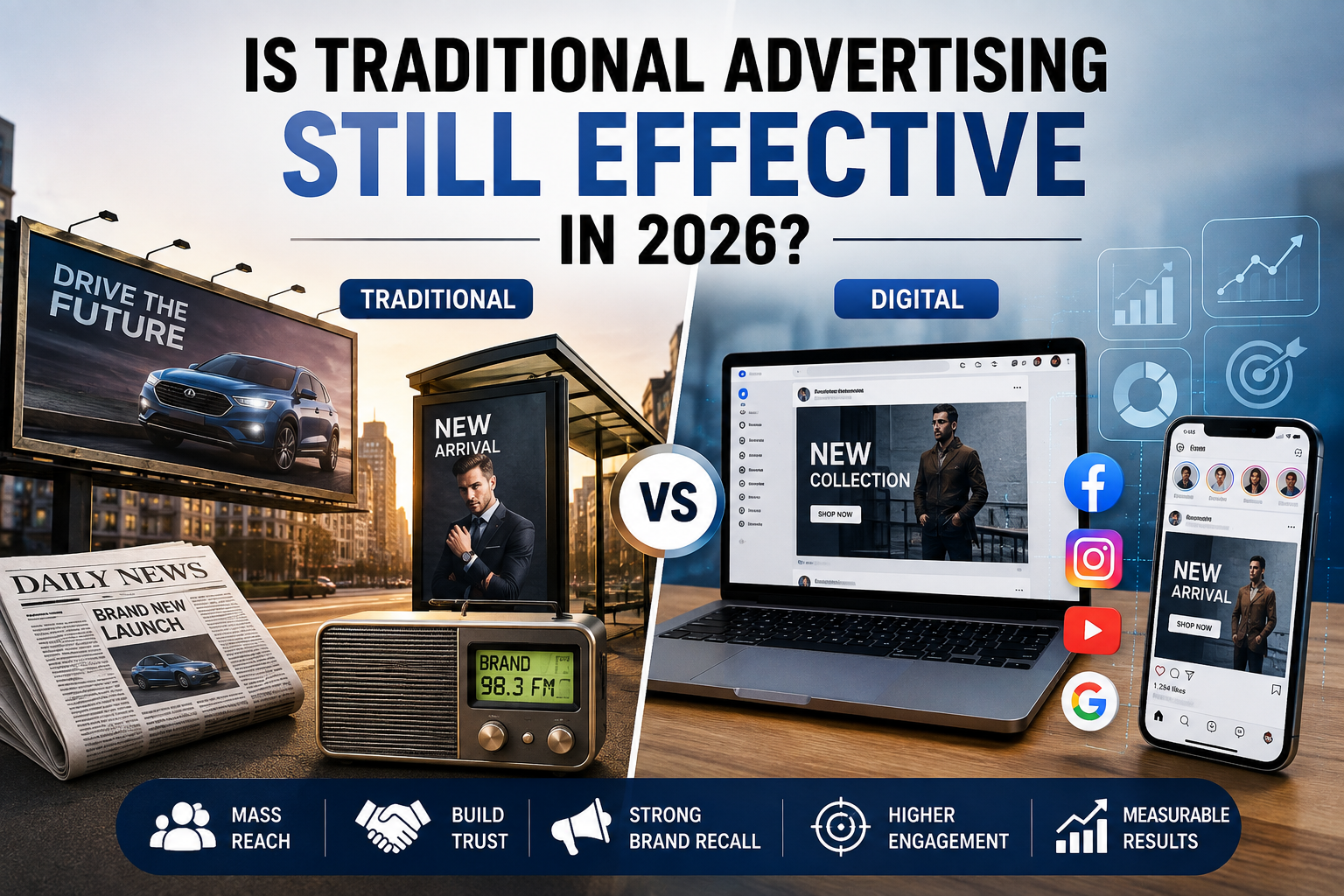

Is Traditional Advertising Still Effective in 2026?
For years, marketers have predicted the death of traditional advertising.
Television was supposed to disappear.
Print was supposed to become irrelevant.
Radio was supposed to be replaced entirely by streaming.
Billboards were supposed to lose their impact in a mobile-first world.
Yet, in 2026, traditional advertising is still here.
More importantly, it is still working.
The real question is not whether traditional advertising has disappeared. The real question is:
Is traditional advertising still effective enough to deserve a place in a modern marketing strategy?
The answer is yes—but not in the same way it worked 10 or 20 years ago.
Digital advertising has undoubtedly transformed marketing. It offers targeting, personalization, automation, real-time optimization, and detailed performance data. In India, digital advertising has moved ahead of television in advertising spend and accounted for 44% of the market in FY2025, while television accounted for 27% and print 18%.
But the growth of digital does not automatically mean that traditional media has become ineffective.
Nielsen’s research continues to emphasize the importance of balancing traditional and digital media, noting that traditional TV remains a significant part of global media consumption and that media planning increasingly requires the right mix rather than an either-or choice.
Traditional advertising still offers something that many digital campaigns struggle to achieve:
Mass reach, physical presence, familiarity, and long-term brand building.
From television commercials and radio ads to newspapers, magazines, billboards, and out-of-home advertising, traditional channels continue to play an important role for the right brands and audiences.
So, let’s look at whether traditional advertising is still effective in 2026—and when it makes sense for your business.
What Is Traditional Advertising?
Traditional advertising refers to marketing channels that existed before the rise of internet-based advertising.
The most common forms include:
- Television advertising
- Radio advertising
- Newspaper advertising
- Magazine advertising
- Billboard advertising
- Out-of-home advertising
- Direct mail
- Flyers and brochures
- Cinema advertising
These channels are generally designed to reach broad audiences rather than targeting individuals based on detailed online behavior.
Digital advertising, on the other hand, includes channels such as:
- Search advertising
- Social media advertising
- Digital video
- Display advertising
- Influencer marketing
- Connected TV
- In-app advertising
- Retail media
The global advertising industry is increasingly digital, but traditional channels remain part of the broader advertising ecosystem. Statista’s 2026 market outlook still categorizes traditional TV, radio, print, and traditional out-of-home advertising as major advertising channels, even as digital platforms continue to reshape overall spending.
This distinction is important because traditional advertising and digital advertising are not always direct replacements for one another.
They often serve different purposes.
Why Traditional Advertising Is Still Effective in 2026
Traditional advertising remains effective because consumer behavior is not entirely digital.
People still:
- Watch live television
- Listen to radio
- Travel on roads
- Visit shopping areas
- Attend cinemas
- Read newspapers and magazines
- Interact with physical spaces
This creates opportunities for brands to reach audiences outside the crowded digital environment.
Here are the biggest reasons traditional advertising still works.
1. Traditional Advertising Delivers Massive Reach
One of the biggest strengths of traditional advertising is scale.
A television campaign during a major sporting event, a high-traffic billboard in a major city, or a popular radio station can reach thousands or even millions of people.
This is particularly valuable for brands that want to build awareness quickly.
Digital advertising is excellent at targeting specific audiences.
But traditional media can create broad market visibility.
For example, a new consumer brand entering a city may use:
- Billboards
- Radio
- Local newspapers
- Television
- Cinema advertising
to quickly make people aware of the brand.
Nielsen’s 2025 analysis shows that traditional media remains an important part of advertising budgets across industries and business sizes. Its data found that major advertisers in sectors such as retail and automotive continue to allocate significant shares of their budgets to traditional channels.
This demonstrates an important point:
Large brands do not continue investing in traditional media simply because of habit. They continue using it because broad reach still has value.
2. Traditional Media Can Build Strong Brand Awareness
Not every advertisement is designed to generate an immediate click.
Some advertising exists to make people remember a brand.
This is where traditional media can be particularly powerful.
A memorable television commercial can stay with consumers for years.
A strategically placed billboard can become part of a city’s visual environment.
A radio jingle can make a brand instantly recognizable.
These formats can repeatedly expose consumers to a brand without requiring them to actively search for it.
Brand awareness is especially important because customers rarely purchase from a brand they have never heard of.
Nielsen has highlighted that traditional channels remain important for building and maintaining brand awareness, particularly in industries that need broad reach or have audiences that are less concentrated on digital platforms.
Digital advertising often focuses heavily on immediate performance.
Traditional advertising can play a different role by helping create the familiarity that makes future conversions easier.
3. Traditional Advertising Can Create More Physical Presence
Digital ads disappear when someone scrolls past them.
A billboard does not.
A newspaper advertisement exists physically.
A large outdoor campaign can become part of the environment.
This physical presence can make advertising feel bigger and more established.
Imagine seeing the same brand:
- On Instagram
- On YouTube
- On a billboard
- On television
The brand suddenly feels larger.
This is one of the biggest advantages of combining traditional and digital advertising.
The channels reinforce each other.
A person might first discover a brand through social media.
Later, they see the same brand on a billboard.
That second exposure can increase familiarity and trust.
The goal is not to choose between physical and digital visibility.
The goal is to create multiple meaningful touchpoints.
4. Out-of-Home Advertising Still Has a Major Advantage
Billboards and out-of-home advertising cannot be skipped with a button.
They cannot be blocked by an ad blocker.
And they do not compete with hundreds of posts in a social media feed.
That makes out-of-home advertising unique.
A strategically placed billboard can repeatedly reach people traveling through the same location.
This is especially valuable for:
- Real estate companies
- Restaurants
- Retail stores
- Automobile brands
- Educational institutions
- Events
- Local businesses
Location also makes traditional out-of-home advertising powerful.
A restaurant can advertise near a busy road.
A real estate project can advertise near its location.
A retail store can promote itself close to a shopping area.
The advertisement appears at a moment when the audience is physically relevant to the business.
Nielsen reported that more marketers were planning increases to traditional media budgets in 2025 than in the previous year, with out-of-home among the channels attracting planned investment increases.
In 2026, the opportunity is becoming even more interesting as traditional outdoor advertising increasingly works alongside digital out-of-home displays and mobile campaigns.
5. Traditional Advertising Can Reach Audiences Digital Campaigns Miss
Not every customer spends all day on Instagram, TikTok, or YouTube.
Audience behavior varies significantly depending on:
- Age
- Location
- Income
- Industry
- Lifestyle
- Media habits
For example, some audiences may be easier to reach through:
- Television
- Radio
- Newspapers
- Local outdoor advertising
- Direct mail
This is particularly relevant in industries with older audiences or highly regulated messaging.
Nielsen notes that sectors such as healthcare and pharmaceuticals can still rely heavily on traditional channels because those formats provide more space for complex or regulated messaging, while their audiences may also be more reachable through linear TV and other traditional media.
The lesson is simple:
Do not choose a marketing channel because it is trendy. Choose it because your audience is there.
6. Radio Is Still More Effective Than Many Marketers Think
Radio is often underestimated.
Because it is harder to measure than digital advertising, marketers sometimes assume that it is less effective.
But measurement and effectiveness are not the same thing.
Nielsen’s 2025 research found a significant gap between marketer perception and actual channel performance. Its Global Compass data indicated that radio, despite being ranked low by marketers in perceived effectiveness, delivered among the highest levels of ROI globally, behind social media.
Radio also works well for:
- Local businesses
- Regional campaigns
- Automobile dealerships
- Retail promotions
- Events
- Restaurants
- Consumer brands
It can reach people during:
- Their commute
- Work
- Travel
- Daily routines
For local businesses, this can be particularly valuable.
The right radio campaign combined with digital retargeting can create a powerful marketing system.
7. Television Advertising Is Changing, Not Simply Disappearing
Television advertising has faced major disruption.
Streaming platforms, connected TV, YouTube, and on-demand content have changed how people watch video.
However, this does not mean television has become irrelevant.
Traditional TV continues to offer reach, especially around:
- Sports
- News
- Major entertainment events
- National programming
Nielsen’s media planning research specifically notes the resilience of traditional television despite increasing competition from streaming and connected TV.
However, advertisers must also recognize the changing market.
In India, television advertising volumes declined during the first seven months of 2026 as advertisers continued shifting spending toward digital channels, according to TAM AdEx data reported by The Economic Times.
This is why the future of television advertising is not simply about buying more traditional TV spots.
It is about understanding the broader video ecosystem.
A modern video strategy might include:
- Linear TV
- Connected TV
- YouTube
- OTT platforms
- Social video
The strongest brands increasingly think about video as one connected ecosystem rather than separating “TV” and “digital” completely.
Traditional Advertising vs Digital Advertising in 2026
The biggest mistake marketers can make is treating this as a battle where one channel must win.
Traditional advertising and digital advertising have different strengths.
Traditional advertising is often stronger for:
- Mass awareness
- Broad reach
- Local visibility
- Brand recognition
- Physical presence
- Repeated exposure
Digital advertising is often stronger for:
- Precise targeting
- Personalization
- Retargeting
- Real-time optimization
- Conversion tracking
- Smaller campaign budgets
The right strategy depends on the business objective.
For example:
A new restaurant may use a billboard to create local awareness and Instagram ads to target nearby customers.
A real estate developer may use outdoor advertising to establish project visibility while using Google and social media to generate leads.
A national consumer brand may use television to build awareness and digital campaigns to convert interested audiences.
The future is not traditional versus digital.
The future is traditional plus digital.
Nielsen’s research repeatedly emphasizes this need for a balanced media mix, while also warning that marketers may overvalue channels simply because they are easier to measure.
When Traditional Advertising Works Best
Traditional advertising is not equally effective for every business.
It tends to work best under certain conditions.
1. When You Need Mass Awareness
If your objective is to make a large number of people aware of your brand, traditional channels can be extremely useful.
Examples include:
- Product launches
- National campaigns
- Major events
- Retail expansion
2. When Your Business Has a Local Audience
Local businesses can benefit from:
- Local radio
- Billboards
- Newspapers
- Flyers
- Transit advertising
A local campaign can sometimes reach the exact community where customers live and work.
3. When Physical Location Matters
Businesses such as:
- Restaurants
- Retail stores
- Real estate projects
- Hotels
- Educational institutions
can benefit significantly from location-based outdoor advertising.
4. When Trust and Brand Size Matter
For some customers, seeing a brand across major media creates credibility.
A brand that appears on television, in print, and on outdoor media may feel more established than a business that exists only through social media ads.
5. When You Are Supporting a Digital Campaign
Traditional advertising becomes even more valuable when it supports digital activity.
A billboard can encourage people to search for a brand.
A television ad can increase branded searches.
A newspaper campaign can direct customers to a website.
This creates an integrated customer journey.
When Traditional Advertising May Not Be the Best Choice
Traditional advertising also has limitations.
It may not be the best option when:
- Your budget is extremely limited
- You need highly precise targeting
- You need immediate conversion data
- Your audience is primarily online
- Your product serves a very niche market
For a small startup with a limited marketing budget, search advertising, social media, and content marketing may initially provide more measurable results.
Traditional advertising often requires larger upfront investment.
A television commercial requires production and media buying.
A billboard requires design, printing or display costs, and placement.
Print campaigns can also be expensive.
That does not mean traditional advertising is ineffective.
It means effectiveness depends on the objective, audience, location, and budget.
How to Measure Traditional Advertising in 2026
One of the biggest criticisms of traditional advertising is that it is difficult to measure.
However, measurement has improved significantly.
Brands can now track the impact of traditional campaigns using:
- Branded search growth
- Website traffic
- QR codes
- Dedicated landing pages
- Unique URLs
- Promo codes
- Location-based analysis
- Customer surveys
- Sales lift
- Media mix modeling
For example, a billboard campaign could use a unique URL.
A radio advertisement could use a specific promotional code.
A television campaign could be measured against changes in branded search and website traffic.
Nielsen notes that measurement capabilities for traditional media have advanced, and that the assumption that digital is automatically easier to measure should not be confused with the question of whether a channel is actually more effective.
The goal should be to measure business impact—not just clicks.
The Best Strategy: Build an Integrated Media Mix
The most effective advertising strategy in 2026 is rarely based on one channel.
Instead, brands should create a connected media system.
For example:
Step 1: Use traditional advertising for awareness
Use:
- Television
- Radio
- Billboards
to reach a broad audience.
Step 2: Use digital advertising for engagement
Use:
- Social media
- Video
- Content marketing
- Influencers
to continue the conversation.
Step 3: Use performance marketing for conversion
Use:
- Google Ads
- Retargeting
- Landing pages
to convert interested audiences.
This creates a full-funnel strategy.
Traditional media introduces the brand.
Digital media helps people explore it.
Performance marketing helps them take action.
That combination can be more powerful than relying entirely on one channel.
Traditional Advertising Trends to Watch in 2026
Traditional advertising is evolving.
Here are some important trends.
1. Connected and Addressable TV
Television advertising is becoming more targeted through connected TV.
This gives advertisers more flexibility than traditional mass-market buying.
2. Digital Out-of-Home
Billboards are becoming more dynamic.
Digital displays can change messaging based on:
- Time
- Location
- Events
- Audience conditions
3. Better Cross-Media Measurement
Brands are increasingly looking at campaigns across both digital and traditional channels.
The goal is to understand the combined impact.
4. Localized Advertising
Local businesses can increasingly combine traditional media with digital targeting.
For example:
Billboard + Google Ads + Instagram + location targeting
can create a powerful local marketing strategy.
5. Brand Building Is Becoming Important Again
As digital advertising becomes increasingly competitive and expensive, businesses are paying more attention to long-term brand building.
Traditional media can play an important role in that process.
So, Is Traditional Advertising Still Effective in 2026?
Yes, traditional advertising is still effective in 2026—but effectiveness depends on how and where it is used.
Traditional advertising is no longer the only way to reach consumers.
Digital channels have become dominant in many markets, and India’s advertising landscape clearly reflects that shift toward digital spending.
But traditional channels have not disappeared.
Television still offers large-scale reach.
Radio can deliver strong returns.
Print remains relevant for specific audiences and industries.
Billboards create physical visibility.
And traditional media continues to be part of the advertising mix for businesses of different sizes.
The smartest marketers in 2026 are not asking:
“Should we choose traditional advertising or digital advertising?”
They are asking:
“What combination of channels will best reach our audience and achieve our business goal?”
That is the real future of advertising.
Traditional advertising is not dead.
It has simply changed roles.
In a world overflowing with digital ads, a well-placed billboard, a memorable television campaign, a powerful radio message, or a trusted print placement can still make a brand stand out.
The key is strategy.
Use traditional advertising when it provides reach, trust, visibility, or audience access that digital alone cannot deliver.
Then connect it with digital channels that help you engage, track, and convert your audience.
In 2026, the most effective advertising is not traditional or digital.
It is integrated.
Take Your Brand Further with Lerdleap
At Lerdleap, we help brands move beyond ordinary marketing with creative, strategic, and results-driven digital solutions. From content and video marketing to branding, social media, and performance-focused campaigns, we create strategies designed to help businesses build visibility, connect with the right audience, and grow in an ever-changing digital world.
Ready to make your brand stand out? Lerdleap is here to help you take the next leap.