
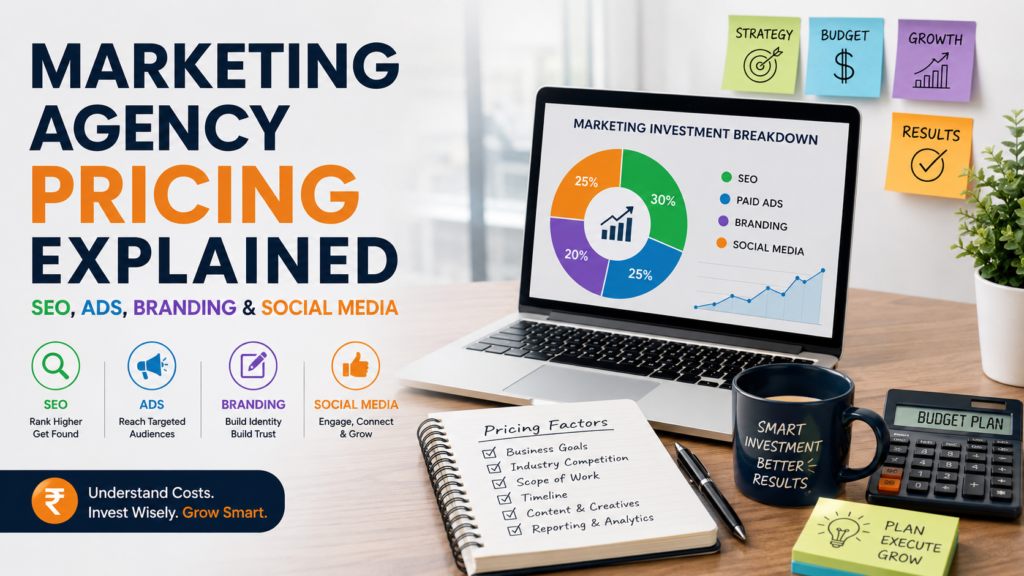
If you’ve ever asked three different agencies for a quotation, you’ve probably received three completely different prices for what looked like the same service.
One agency offers SEO for ₹20,000 per month.
Another quotes ₹75,000.
A third agency says, “Let’s schedule a strategy call.”
The confusion isn’t because agencies are trying to confuse clients. The real reason is that marketing isn’t a fixed product like buying a laptop or office chair. Every business has different goals, competition levels, audiences, timelines, and growth expectations.
Understanding Marketing Agency Pricing helps business owners make smarter decisions instead of choosing the cheapest proposal or the most expensive one.
This guide explains how agencies calculate pricing for SEO, paid advertising, branding, social media marketing, content creation, and complete digital marketing services. More importantly, it shows what you’re actually paying for and how to determine whether an agency is worth the investment.
Why Marketing Agency Pricing Is Never the Same
Imagine two restaurants.
One serves 40 customers daily.
The other serves 2,000 customers every day.
Would they spend the same amount on marketing?
Absolutely not.
Similarly, a startup launching its first product has very different marketing needs compared to an established company entering a new city.
That is why Marketing Agency Pricing depends on business complexity rather than company size alone.
Agencies usually evaluate factors like:
- Business goals
- Industry competition
- Geographic target
- Number of services required
- Content production
- Advertising budget
- Reporting requirements
- Team involvement
- Growth timeline
Pricing reflects the amount of expertise, planning, execution, and optimization needed—not simply the number of hours worked.
What Are You Actually Paying For?
Many businesses think they’re paying for social media posts or SEO keywords.
In reality, they’re paying for decisions.
Every campaign involves professionals who research markets, study competitors, analyze customer behavior, create strategies, optimize campaigns, monitor data, solve unexpected problems, and continuously improve results.
A marketing campaign often includes:
- Market research
- Competitor analysis
- Customer profiling
- Campaign planning
- Copywriting
- Graphic design
- Video production
- Technical SEO
- Paid advertising optimization
- Landing page improvements
- Analytics reporting
- Conversion optimization
These activities determine whether marketing generates revenue or simply creates impressions.
Businesses can also use Google Analytics Marketing Measurement to understand how traffic, user behavior, and conversions contribute to overall marketing performance.
Understanding this changes how businesses view Marketing Agency Pricing.
SEO Pricing: Why Two Agencies Quote Completely Different Prices
SEO appears simple from the outside.
Publish content.
Rank on Google.
Get traffic.
The reality is much more demanding.
Professional SEO combines technical expertise, user experience improvements, content strategy, website optimization, authority building, keyword research, and continuous monitoring.
Pricing depends on several variables.
Website Size
A 15-page website requires significantly less work than a 5,000-page eCommerce platform.
Competition
Ranking for “Digital Marketing Company” requires much greater investment than ranking for a niche local keyword.
Current Website Health
Some websites need only optimization.
Others require complete technical reconstruction.
Content Requirements
Publishing two articles monthly costs less than producing twelve in-depth industry resources.
Authority Building
Acquiring quality backlinks requires planning, outreach, relationship building, and editorial content.
Typical SEO pricing often includes:
- Technical audits
- Keyword research
- Content planning
- On-page optimization
- Internal linking
- Schema implementation
- Monthly reporting
- Performance tracking
- Link-building strategies
- Competitor monitoring
Businesses comparing Marketing Agency Pricing should focus on deliverables instead of only monthly fees.
If you’re evaluating multiple growth channels together, explore our Digital Marketing Services to understand how SEO, paid advertising, content, and analytics work as one integrated strategy.
Paid Advertising Pricing Isn’t Just About Running Ads
Many business owners believe agencies simply click “Publish Campaign.”
Modern advertising is far more sophisticated.
Before launching ads, agencies often spend considerable time understanding customer intent.
They analyze:
- Customer journey
- Buying behavior
- Market demand
- Competitor messaging
- Creative performance
- Landing page quality
- Audience segmentation
Campaign management usually includes:
- Campaign structure
- Audience creation
- Keyword research
- Bid optimization
- Creative testing
- Conversion tracking
- Budget optimization
- Weekly reporting
- Continuous experimentation
Most agencies charge using one of three approaches.
Monthly Management Fee
A fixed monthly fee regardless of advertising spend.
Suitable for businesses with consistent budgets.
Percentage of Ad Spend
The management fee increases as advertising investment increases.
Example:
- Ad Spend: ₹2,00,000
- Agency Fee: 12%
Management Cost = ₹24,000
Hybrid Model
A fixed management fee combined with performance-based optimization.
When comparing Marketing Agency Pricing, ask whether creative production, landing page optimization, analytics setup, and reporting are included.
Learn how a dedicated Performance Marketing Agency manages ad budgets, campaign optimization, and ROI-focused growth for businesses.
Branding Costs: More Than Just Designing a Logo
Branding creates business perception.
Customers often decide whether they trust a company before reading a single product description.
Professional branding includes:
- Brand positioning
- Customer research
- Brand voice
- Messaging framework
- Logo development
- Typography
- Color psychology
- Visual identity
- Brand guidelines
- Marketing templates
The depth of research directly affects pricing.
Some agencies spend weeks interviewing stakeholders and customers before beginning design.
Others skip research entirely.
The difference becomes visible over time.
Businesses choosing branding services should understand how research influences Marketing Agency Pricing.
Social Media Pricing Depends on Content Complexity
Posting daily images isn’t social media marketing.
Successful brands build communities.
Agency pricing depends on:
- Number of platforms
- Content volume
- Video production
- Photography
- Motion graphics
- Community management
- Influencer collaborations
- Monthly campaigns
- Paid promotion
- Performance reporting
For example:
Posting twelve static graphics monthly requires fewer resources than creating professional reels, interviews, animations, and campaign videos.
That’s why Marketing Agency Pricing varies significantly even for businesses in the same industry.
Content Marketing Pricing: Quality Costs Less Than Poor Content
Poor content creates hidden costs.
Low-quality articles rarely rank.
Weak copy reduces conversions.
Generic blogs attract little traffic.
Professional content creation includes:
- Search intent research
- Topic planning
- Original writing
- Editing
- SEO optimization
- Internal linking
- Visual recommendations
- Publishing support
A single high-quality article can generate business for years.
Businesses often underestimate the long-term value when evaluating Marketing Agency Pricing.
What Influences Marketing Agency Pricing More Than Most Businesses Realize?
Several hidden factors affect project costs.
Industry Competition
Healthcare, finance, real estate, education, and SaaS markets require greater expertise than less competitive industries.
Geographic Competition
Ranking nationally costs more than ranking locally.
Advertising in metropolitan markets generally requires larger budgets.
Project Timeline
Launching within ten days demands more resources than a six-month rollout.
Content Volume
Creating:
- Blogs
- Videos
- Landing pages
- Infographics
- Email campaigns
requires different specialists.
Reporting Requirements
Some clients need monthly reports.
Others require:
- Weekly dashboards
- Daily campaign monitoring
- Executive summaries
- Stakeholder presentations
Each additional requirement increases agency involvement.
The Cheapest Proposal Often Becomes the Most Expensive
Businesses frequently compare only monthly fees.
Consider this example.
Agency A charges ₹20,000 monthly.
Agency B charges ₹50,000 monthly.
Agency A:
- Minimal strategy
- Basic reports
- Generic content
- Limited optimization
Agency B:
- Comprehensive research
- Conversion optimization
- Professional content
- Landing page improvements
- Weekly optimization
- Continuous testing
If Agency B generates five times more revenue, its higher fee actually produces lower acquisition costs.
Looking only at Marketing Agency Pricing without evaluating outcomes can become an expensive mistake.
Questions Every Business Should Ask Before Hiring an Agency
Instead of asking,
“Why are you expensive?”
Ask:
- What exactly is included?
- How often will campaigns be optimized?
- Who manages my account?
- How are results measured?
- Which tools are included?
- How frequently will we communicate?
- What deliverables are guaranteed?
- What happens if priorities change?
These questions reveal far more than price comparisons.
Pricing Models Used by Marketing Agencies
Understanding pricing structures helps businesses choose the right partnership.
Monthly Retainer
Ideal for ongoing growth.
Includes continuous optimization and reporting.
Project-Based Pricing
Suitable for:
- Website launches
- Branding projects
- SEO audits
- Marketing strategy development
Hourly Consulting
Useful for businesses needing expert guidance without full-service management.
Performance-Based Pricing
Agency compensation depends on agreed performance metrics.
Not suitable for every project because many variables remain outside agency control.
Hybrid Pricing
Combines fixed retainers with measurable performance incentives.
Many growing businesses prefer this model because it balances stability with accountability.
Hidden Costs Businesses Often Forget
Marketing investment extends beyond agency fees.
Additional expenses may include:
- Advertising budgets
- Photography
- Video production
- Marketing software
- CRM integrations
- Landing page development
- Email platforms
- Premium analytics tools
Discuss these expenses early to avoid surprises.
Transparent Marketing Agency Pricing includes clear explanations of what is and isn’t covered.
How to Compare Two Agency Proposals Fairly
Never compare prices alone.
Instead, compare:
| Evaluation Factor | Agency A | Agency B |
|---|---|---|
| Strategy Included | ✔ | ✔ |
| Dedicated Account Manager | ✔ | |
| Reporting Frequency | Monthly | Weekly |
| Technical SEO | Basic | Advanced |
| Creative Design | Limited | Included |
| Video Production | Extra | Included |
| Conversion Optimization | No | Yes |
| Landing Pages | Extra | Included |
| Communication | Calls + Dashboard |
A higher proposal often delivers significantly greater long-term value.
If you’re in the property sector, this guide on choosing a Real Estate Marketing Agency explains what specialized industry expertise looks like and what services should be included.
Warning Signs of Unrealistic Pricing
Be cautious if an agency promises:
- Guaranteed first-page rankings
- Thousands of followers overnight
- Instant leads
- Viral campaigns every month
- Unlimited revisions forever
- Extremely low pricing with extensive deliverables
Professional marketing requires expertise, testing, and continuous refinement.
Unrealistic promises usually lead to disappointing outcomes.
Building a Marketing Budget That Supports Growth
Instead of asking,
“What’s the cheapest agency?”
Ask,
“What investment helps my business reach its next stage?”
Businesses growing steadily often review budgets every quarter rather than treating marketing as a fixed monthly expense.
As revenue grows, marketing investments usually expand to include:
- Better creative production
- Additional channels
- Automation
- Advanced analytics
- Customer retention campaigns
- Brand-building initiatives
Viewing Marketing Agency Pricing as a growth investment rather than a recurring expense encourages smarter, long-term decisions.
How Transparency Builds Better Agency Relationships
The strongest partnerships are built on clarity.
Businesses should understand:
- Scope of work
- Timelines
- Deliverables
- Communication process
- Success metrics
- Review schedules
- Additional costs
Likewise, agencies should understand the client’s expectations, priorities, and business objectives.
Transparent communication reduces misunderstandings and creates stronger long-term results.
Final Thoughts
Choosing a marketing partner should never be based solely on the lowest quotation. A lower price may reduce short-term spending but increase long-term costs through missed opportunities, weak campaigns, or slow business growth.
The real purpose of understanding Marketing Agency Pricing is to know what value you receive for your investment. Whether you’re hiring an agency for SEO, paid advertising, branding, social media, or a complete digital marketing strategy, look beyond the numbers on the proposal.
Ask detailed questions. Compare deliverables. Evaluate experience. Review reporting processes. Understand how success will be measured.
A reliable agency doesn’t simply execute marketing tasks—it becomes a strategic partner that helps your business attract the right audience, generate qualified leads, strengthen your brand, and achieve sustainable growth.
When you evaluate pricing with this mindset, you stop asking, “How much does it cost?” and begin asking the more valuable question: “How much growth can this investment create?” That shift is what leads to better decisions, stronger partnerships, and measurable business success.