
1. Placement — Location Intelligence & Sightline Science
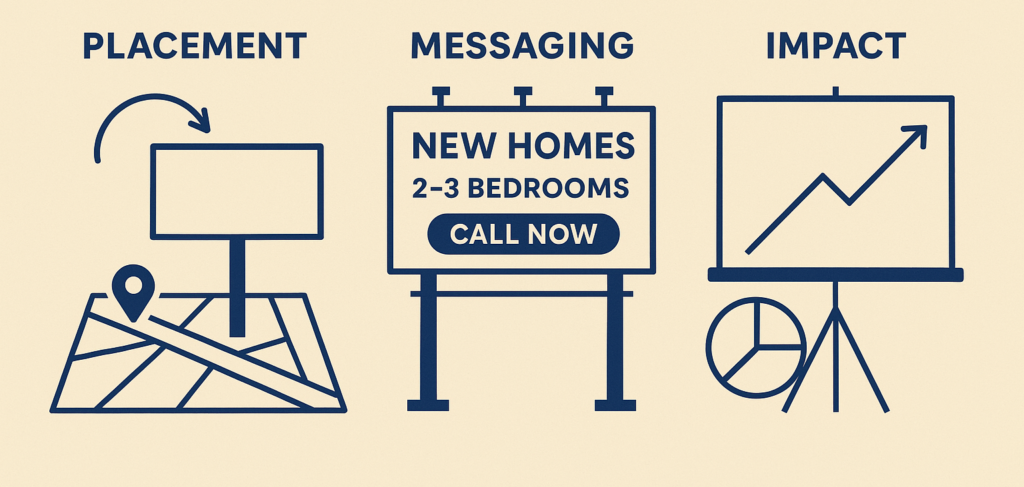
Core principle
A hoarding’s value is directly proportional to qualified impressions per hour — meaning not just eyeballs, but the right eyeballs (commuters, local buyers, high-net-worth individuals, footfall near agents).
Hoarding Strategy Placement checklist
- Traffic type: Identify corridors with target prospects — arterial roads for commuters, high streets for retail buyers, boulevards near corporate hubs for luxury inventory.
- Sightline & angle: Use side-view hoardings on curves and head-on hoardings for straight approaches. Legibility distances grow with font size: every 1 inch of letter height ≈ 10–15 feet readable distance.
- Speed vs. dwell time: For vehicles at 60 km/h, prioritize shorter, punchy headlines and single visual. For intersections/parking areas, use more copy and a QR or short code.
- Height & elevation: Lower hoardings perform better for pedestrian-level offerings; elevated billboards suit highway branding.
- Proximity to site: Site hoardings (perimeter hoardings) are highest intent — buyers seeing a project at the site are more likely to inquire.
- Clustering & frequency: Use 3–5 hoardings in a 2–5 km radius to ensure repeated exposure (recency + frequency).
- Micro-targeting: Place near showrooms, metro stations, corporate parks, premium supermarkets depending on buyer persona. Use footfall heatmaps where available.
Tools & data sources (implementation)
- Local traffic studies, Google Maps heatmaps, municipal footfall reports, mobility datasets, and ad network CPM/CPV data.
- Use basic location scoring: (Daily vehicle count × % of target demo) ÷ distance from site = priority score.
2. Messaging — Headline, Subcopy, CTA, Brand Signals
Search intent matters: three messaging buckets
- Brand & trust (long-term): Emphasize developer credibility, USP, awards. Use on highways and long-duration exposures.
- Lead generation (short-term): Emphasize inventory availability, limited units, price starting, and inquiry numbers. Perfect for showrooms & feeder roads.
- Directional / Local (hyperlocal): “Site next to X mall — Visit site now.” For perimeter hoardings and nearby intersections.
Headline formula (tested)
[Primary Benefit] + [Target] + [Urgency/Proof]
Examples:
- “2 BHKs From ₹49.9L — Launch Offer (Limited Units)”
- “Luxury Penthouses by XYZ Group — 60% Sold”
- “Move-in Ready Homes Near Tech Park — Visit Today”
Copy & CTA rules
- Keep headline ≤ 6 words for moving traffic.
- CTA must be explicit: “Call”, “Visit”, “Book Site Visit”, or a short numeric code/WhatsApp number. Prefer local number format with country code suppressed for local hoardings.
- Use QR for conversion but pair with short text for those who can’t scan. Place QR in lower-right at 1.5–2× eye height.
- Social proof (logos, awards, certification) improves trust. Add “RERA Reg. No.” if applicable — it reduces friction for Indian audiences.
Persona-targeted language
- Investors: ROI, rental yield, appreciation, launch price.
- First-time buyers: EMI equivalents, starter plans, flexible downpayment.
- Luxury buyers: Exclusivity, designer amenities, privacy, concierge.
3. Creative & Legibility — Fonts, Colors, Imagery
Legibility checklist
- Font size: For highway boards, headline fonts > 36–48 inches (large scale). For site hoardings seen at close range, 6–12 inch letter height is fine.
- Typeface: Use bold, geometric sans-serifs for headlines (read faster at speed). Keep brand typefaces minimal.
- Contrast: Text-to-background contrast ratio should be high (dark text on light or vice versa). Avoid busy images behind small text.
- Color psychology: Blue = trust; green = environment; gold/black = luxury. Use sparingly and within brand palette.
- Imagery: Use one hero image — facade or lifestyle shot — avoid collages. For distance-reading, favor silhouette or building outline.
Composition rules
- Hierarchy: Headline (top 30% visual weight) → 1-line supporting copy → CTA & contact block (bottom-right).
- White space: Resist filling every inch; whitespace aids readability.
- Brand lockup: Keep developer logo and RERA/partner logos in corners sized to be legible but not dominating.
4. Impact Measurement — KPIs, Attribution & Offline→Online Paths
Primary KPIs
- Impressions (estimated): Use traffic counts × viewability factor.
- Leads generated: Calls, WhatsApp clicks, form submissions, showroom visits.
- Conversion rate: Leads → site visits → bookings.
- Cost per lead (CPL) and Cost per booking — for ROI calculations.
- Brand lift metrics: Search volume uplift, direct brand traffic spikes, branded queries.
Attribution methods
- Unique tracking numbers: Use a dedicated phone or short code for each hoarding or cluster.
- Short URLs & UTM tags: Pair with QR codes and short slugs (e.g., projectname.in/offer).
- Promo codes: Issue hoarding-specific promo codes to track conversions.
- Surveys at point-of-contact: Ask “How did you hear about us?” at showroom or booking stage.
- Digital correlation: Monitor spikes in Google Trends and branded searches during hoarding run windows.
Example ROI formula
Monthly bookings × avg profit per booking − (hoarding cost + creative cost + activation fees) = Net ROI. Track weekly lead-to-booking velocity for validation.
5. Permissions, Compliance & Cost Benchmarks
Permits & legal
- Municipal approvals: City corporation permits, zone compliance, and buffer restrictions near government buildings.
- Safety & structural checks: Especially for large elevated hoardings.
- RERA & regulatory display requirements: Display registration numbers where required.
Cost guide (benchmarks, vary by city)
- Site hoardings (perimeter): Often lower CPM and high intent — cost depends on site size and duration.
- Large-format highways: Premium rates, higher impression volumes.
- Creative & production: One-time cost for printing, installation, and maintenance. Factor in night-time illumination cost.
- Lighting & digital: Backlit hoardings add 10–40% to costs; digital DOOH can be CPM-based.
6. Optimization Checklist & A/B Testing for Hoardings
A/B test ideas (practical)
- CTA Test: “Call Now” vs “Scan QR” vs “Visit Showroom” — measure which yields higher qualified leads.
- Headline Test: Price-led vs amenity-led vs urgency-led.
- Visual Test: Facade image vs lifestyle image.
- Placement Test: Cluster A (near mall) vs Cluster B (near transit hub) for same creative.
Optimization cadence
- First 14 days: Evaluate call volume and QR scans.
- Day 15–30: Adjust copy or relocate smaller movable hoardings if permitted.
- Month 2: Reassess frequency mix and creative rotation.
7. Sample Hoarding Copy & Templates (Plug-and-Play)
Template A — High-speed highway (short)
Headline: “2 BHKs From ₹49.9L”
Subcopy: “Limited launch units. Book now.”
CTA block: “Call 98XXXXXXX | Scan”
Template B — Site hoarding (local)
Headline: “Your Home at [Landmark]”
Subcopy: “Visit site, 10 AM–6 PM | RERA: XXXX”
CTA block: “Walk-in or WhatsApp: 9XXXXXXX”
Template C — Luxury (brand)
Headline: “[Developer] Presents: [Project Name]”
Subcopy: “Private terraces, concierge, 24/7 security.”
CTA block: “Exclusive preview — RSVP: call/website”
8. Case Study Snapshots (What Works)
- Perimeter hoardings for mid-segment housing: Generated 35% of walk-ins in month 1 with clear “Visit Site” CTA and dedicated tracking number.
- Highway branding for luxury product: Increased branded searches by 48% in 30 days; bookings followed after two showroom activations.
- QR + Promo code: A gated launch with hoarding-specific QR + code resulted in 18% conversion from initial scanned leads.
9. 30-Point Quick Action Plan (Immediate to 90 days)
- Map 20 candidate hoarding placements near target demo.
- Score each by traffic, demo fit, sightline, and permit feasibility.
- Select 3 primary and 2 backup locations.
- Design 2 creative variants (short headline, long headline).
- Create hoarding-specific phone number and QR short link.
- Add RERA and partner logos.
- Produce backlit versions for night visibility (where effective).
- Obtain municipal permits 30 days ahead.
- Install in phases—one cluster first.
- Track calls & QR scans daily.
- Run A/B on headline after 14 days.
- Monitor branded search volumes weekly.
- Reallocate budget toward higher-performing cluster.
- Rotate creatives every 45–60 days.
- Use promo codes to measure offline→online conversions.
- Capture “how did you hear” at every showroom interaction.
- Pair hoardings with digital retargeting for viewers (where possible).
- Collate monthly CPL and compare to digital channels.
- Audit physical condition weekly (damages, vandalism).
- Negotiate multi-month discounts for continuous runs.
- Use local events calendar to boost placement timing.
- Ensure ADA and safety compliance.
- Consider programmatic DOOH for urban centers.
- Test QR placement at two different heights.
- Add environment-friendly messaging if green amenities exist.
- Keep lead response SLA under 1 hour.
- Train sales to ask for source attribution.
- Document learnings and update placement matrix.
- Scale successful clusters to neighboring zones.
- Quarterly strategic review: reposition or renew.
Conclusion — Build a Search-Intent Driven Hoarding Program
A hoarding strategy built around location intelligence, crisp conversion-focused messaging, and rigorous measurement beats random placements and aesthetic-only boards. Site hoardings drive intent; highway hoardings build brand; creative and legibility decide conversion. Combine unique tracking IDs, QR short links, and periodic A/B testing to turn impressions into measurable bookings. Use the 30-point action plan above as your execution checklist — it’s the operational bridge between SERP-level content (that brings buyers to your website) and offline visibility (that brings buyers to your site visit). Implement, measure, optimize, and repeat.