
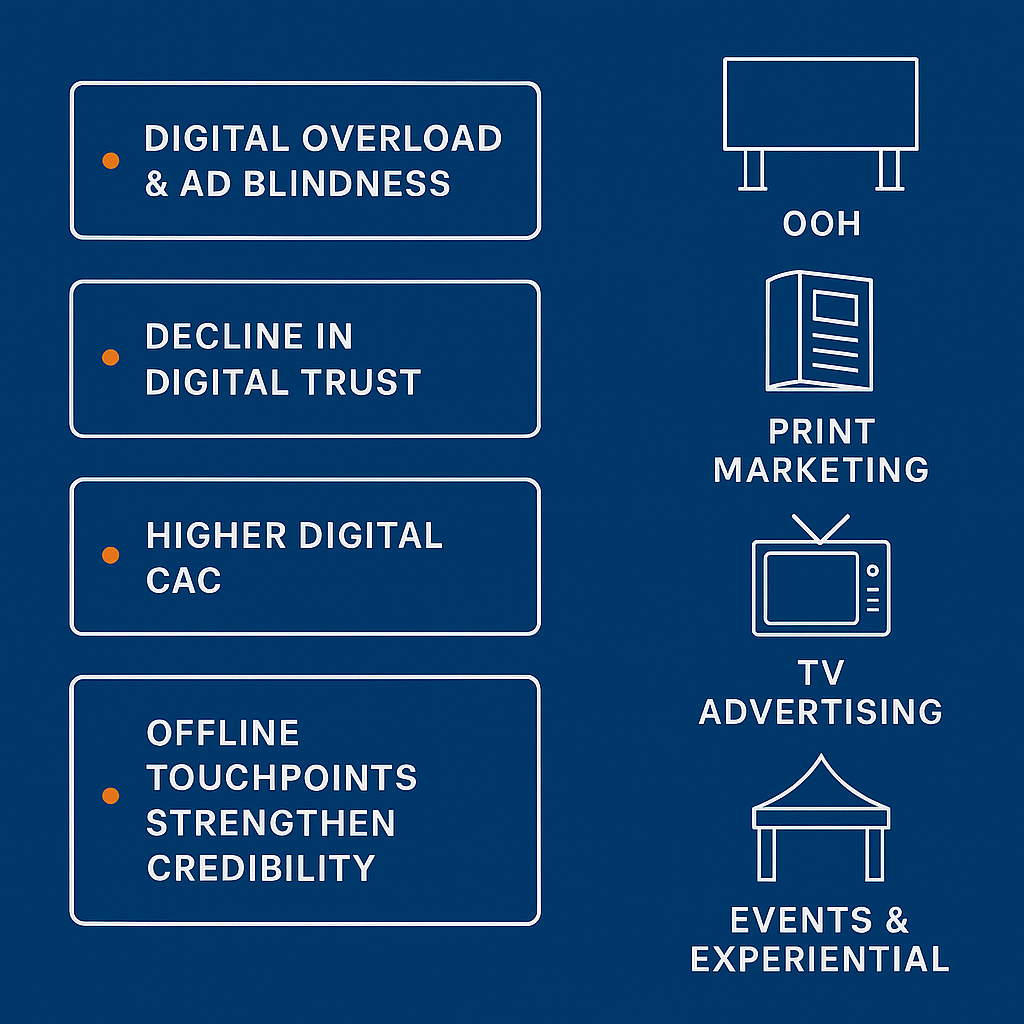
1. Why Traditional Marketing Is Making a Comeback
Digital marketing hasn’t failed — it has become overcrowded.
Every day:
- Ads follow users across platforms
- Algorithms decide what gets seen
- Clickbait floods feeds
- Consumers skip ads or ignore them
- Brands fight shrinking organic reach
- Acquisition costs keep rising
Digital fatigue is real.
The Result?
People now pay more attention to offline, tangible, real-world brand interactions.
In 2025, traditional marketing offers what digital can’t:
- Trust
- Memorability
- Physical presence
- Non-skippable messaging
- Emotional impact
- Real-world brand authority
2. What Counts as Traditional Marketing? (Complete List)
Traditional marketing includes any physical-world advertising or non-digital communication:
✔ Print Advertising
Flyers, brochures, newspapers, magazines, catalogues.
✔ Outdoor / OOH
Billboards, banners, hoardings, bus shelters, transit ads.
✔ TV & Radio Advertising
Local and national broadcast campaigns.
✔ Direct Mail
Postcards, invites, printed offers.
✔ Events & Exhibitions
Trade shows, roadshows, product launches, experiential booths.
✔ Telemarketing
Sales calls, follow-up calling campaigns.
✔ Retail Branding
POS branding, signage, walk-in promotions, in-store demos.
Semantic Keywords:
print advertising, outdoor marketing, OOH 2025, experiential marketing, TV radio ads, traditional branding channels
3. What Triggered the Revival of Traditional Marketing?
This comeback didn’t happen overnight. Several new-generation triggers accelerated it.
3.1 Digital Overload & Ad Blindness
Users see 6,000–10,000 digital ads per day.
Attention spans are shrinking, and people scroll faster than ever.
Traditional marketing breaks the pattern.
A billboard on a highway or a standee in a mall cannot be “skipped.”
3.2 Decline in Digital Trust
Fake influencers.
Fake reviews.
AI-generated content.
Deepfake ads.
People trust physical presence more than digital promises.
3.3 Higher Digital CAC (Cost per Acquisition)
Paid ads have become expensive due to:
- Competition
- Pixel tracking restrictions
- Privacy laws
- Data loss from iOS updates
- Cookie-less browsing
Brands need offline channels to balance CAC.
3.4 Offline Touchpoints Strengthen Credibility
Seeing a brand in the real world feels more legitimate.
A billboard
- a radio ad
- an Instagram campaign
= high trust + high reach + high conversion.
3.5 Connected Offline-to-Online Technology
Traditional marketing is now trackable thanks to:
- QR codes
- UTM links
- Short URLs
- NFC tags
- Geo-targeting
- AI-driven DOOH (Digital Out-of-Home)
- Offline → CRM integrations
This makes traditional marketing performance measurable.
4. Data: Traditional Marketing ROI in 2025
Recent trends show a measurable boost:
- OOH delivers 40% higher brand recall than digital ads
- Print advertising boosts credibility by 35%
- TV still influences 70% of major purchase decisions
- Radio ads generate high frequency at low cost
- Offline + online campaigns convert 2–3× better than digital alone
Traditional marketing is no longer the “old way.”
It’s the high-trust, high-impact partner of digital.
5. The New Hybrid Model: Offline + Online Integration
The future is not traditional OR digital — it is integrated marketing.
Here’s the complete 2025 synergy model:
5.1 Offline → Online Conversion
Examples:
- Billboard with QR code → Landing page → Retargeting ads → Lead
- Brochure CTA → Website form → Email sequence
- TV ad → Google search → Purchase
- Retail signage → WhatsApp automation
Offline creates attention.
Online captures conversion.
5.2 Digital → Offline Reinforcement
Examples:
- Instagram ad → mall event
- YouTube video → offline store visit
- LinkedIn campaign → conference booth
- Website popup → print catalogue request
Digital creates awareness.
Offline delivers trust and experience.
6. Types of Traditional Marketing That Are Booming Again
Here are the traditional channels seeing explosive revival.
6.1 OOH (Out-of-Home Advertising)
Billboards, hoardings, gantries, bus ads, metro ads, airport branding.
Why It Works in 2025:
- Non-skippable
- Long exposure
- Local hyper-targeting
- Perfect for geo-brand dominance
- Works beautifully with QR codes
Semantic Keywords:
outdoor advertising, OOH revival, billboard marketing strategy, transit ads 2025
6.2 Print Marketing
Magazines, flyers, catalogues, coffee-table books.
Print feels premium in the digital era.
- High trust
- Great for luxury, real estate, automobile, education
- Long-lasting (magazines stay for months)
6.3 TV Advertising (Smart TV Era)
Smart TVs now track:
- Interests
- Demographics
- Locations
This makes TV more precise and affordable.
TV + YouTube = unbeatable brand recall.
6.4 Radio Advertising
With car usage increasing, radio remains powerful.
Great for:
- Restaurants
- Local businesses
- Events
- FMCG
- Retail chains
6.5 Events & Experiential Marketing
The fastest-growing traditional channel.
Consumers crave physical experiences, such as:
- Brand exhibits
- Product demos
- Mall activations
- Roadshows
- Pop-up stores
7. The Traditional Marketing Framework for 2025
Here’s a full, integrated, search-intent-rich framework:
Step 1 — Identify Offline Touchpoints
Choose channels based on:
- Geography
- Audience
- Budget
- Product category
- Buying cycle
Step 2 — Create Unified Messaging
Ensure the same:
- brand promise
- colors
- tagline
- CTA
- visual identity
Across offline + online.
Step 3 — Add Trackable Offline Elements
- QR
- Short URLs
- Coupon codes
- NFC tags
- Custom phone numbers
- Geo UTM links
Step 4 — Build the Offline + Online Funnel
Example:
- Billboard →
- QR scan →
- Landing page →
- Add to CRM →
- WhatsApp nurturing →
- Sales call →
- Conversion
Step 5 — Measure Using Integrated KPIs
Offline KPIs:
- Footfall
- QR scans
- Coupon redemptions
- Phone call tracking
- Survey attribution
- Brand recall score
Online KPIs:
- Website sessions
- Landing page CVR
- CAC
- Remarketing performance
Combined KPIs:
- Multi-touch attribution
- Media mix modeling
- Incremental lift
- Full funnel ROAS
8. Industries Benefiting Most from Traditional Marketing Revival
Real Estate
Billboards, brochures, events = extremely high conversion.
FMCG
In-store branding and OOH dominate impulse buying.
Retail Brands
Storefronts, mall activations, flyers boost footfall.
Automobile
Test drives + events still beat digital.
Education
Print + radio + hoardings remain conversion-heavy.
Healthcare
Local trust matters; offline does wonders.
9. Is Traditional Marketing Better Than Digital Marketing?
The winner is neither.
The winner is integration.
Traditional Does Best:
- Trust
- Recall
- Local dominance
- Authority
- Emotional connection
Digital Does Best:
- Precise targeting
- Analytics
- Retargeting
- Automation
- Personalization
When combined:
They produce unbeatable results.
10. Future of Traditional Marketing (2025-2030 Predictions)
Here’s what’s ahead:
10.1 AI-Powered DOOH
Smart billboards changing in real-time based on:
- Traffic
- Weather
- Time
- Audience demographics
10.2 Offline Behavior Tracking
AI will map how many people saw your billboard.
10.3 NFC & AR Experiences
Scan a poster → see 3D experience.
10.4 Personalized Traditional Marketing
Printed materials dynamically customized per audience segment.
10.5 Retail Media Networks
Stores will sell ad space inside their premises like digital platforms.
11. Conclusion — Traditional + Digital = The New Marketing Powerhouse
The revival of traditional marketing isn’t an accident.
It’s a correction.
People want authenticity.
Brands need memorability.
Markets demand trust.
Traditional marketing provides all three — while digital provides speed, data, and precision.
In the digital age, the strongest strategy is:
**Use traditional marketing to build trust.
Use digital marketing to convert it.**
Together, they create a marketing engine built for 2025 and beyond.