
1. What Is Integrated Marketing in 2025?
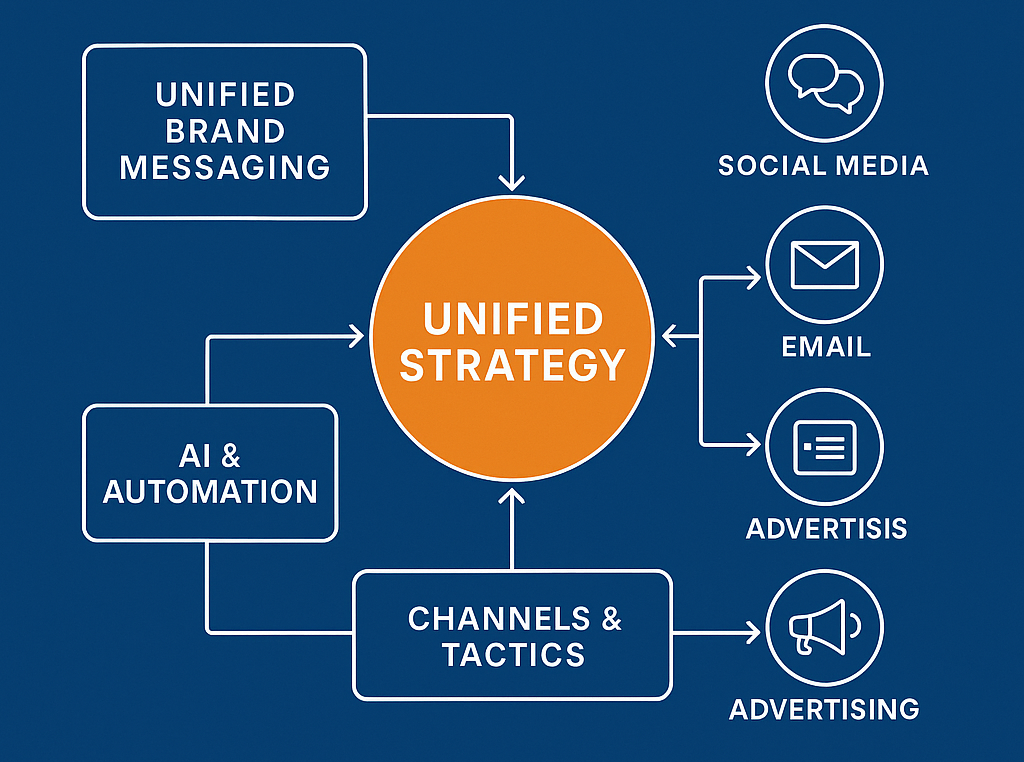
Integrated Marketing in 2025 means creating one connected brand experience across all touchpoints — online, offline, paid, owned, earned, and AI-driven channels — using unified messaging, unified tech stack, unified data, and unified measurement.
✔ Old Marketing
Each channel works independently.
Instagram runs its own campaign.
Sales team sends its own messages.
Website content has its own tone.
Agencies execute in silos.
✔ Integrated Marketing (2025 Model)
Everything works together:
- One unified message
- One brand voice
- One content strategy
- One analytics system
- One customer journey
Every channel reinforces every other channel.
2. Why Integrated Marketing Is Critical in 2025
Consumer behavior has evolved dramatically. People expect:
- The right message → at the right time → on the right platform
- Seamless online-offline transition
- Personalization across every touchpoint
- Relevant content based on intent
- Zero friction from awareness to purchase
Brands that deliver this win. Brands that don’t → become irrelevant.
2025 Market Forces Driving Integrated Marketing
2.1 AI-Driven Consumer Behavior
AI recommendation engines shape everything — Instagram feeds, YouTube suggestions, Google results, Amazon product visibility.
Integration ensures your brand stays consistent in all these algorithm-driven ecosystems.
2.2 Cookie-less Future & First-Party Data
Facebook, Google, and browsers limit tracking.
Only integrated marketing that uses first-party data + unified CRM will survive.
2.3 Multi-Screen & Multi-Platform User Journeys
Consumers switch between:
Smartphones → Laptop → Smart TV → Offline Store → WhatsApp → Website → Email
Brands must follow them.
2.4 Rises of Voice Search & AI Chatbots
Brand messaging must stay consistent across alexa, voice queries, AI search results, ChatGPT plugins, customer support bots.
2.5 Offline + Digital Fusion
Hoardings, posters, events, QR codes, digital screens, retail touchpoints must feed into:
- retargeting
- CRM journeys
- automation flows
This is only possible through Integrated Marketing.
3. The Components of an Integrated Marketing Strategy (2025 Model)
Here is the 8-pillar integrated marketing framework, engineered for SERP dominance.
3.1 Unified Brand Messaging
Every channel communicates ONE story.
- Brand promise
- Tagline
- Tone of voice
- Value proposition
- Visual identity
- Core benefits
- Emotional triggers
Consumers trust brands that feel consistent across every touchpoint.
Semantic Keywords:
brand alignment, unified brand communication, message consistency, integrated content strategy
3.2 Centralized Data & Analytics Ecosystem
In 2025, data is no longer scattered.
Integrated marketing uses:
- One CRM
- One analytics dashboard
- One attribution model
- One audience segmentation system
- One performance reporting framework
Tools used:
HubSpot, Salesforce, GA4, Mixpanel, Hotjar, CDPs, AI-driven BI dashboards.
Benefits:
➤ Full-funnel visibility
➤ Better personalization
➤ Lower CAC
➤ Higher retention
3.3 Cross-Channel Content Engine
A single idea → multiple content formats:
- Long blogs
- YouTube videos
- Short reels
- Infographics
- LinkedIn posts
- Podcast snippets
- Case studies
- Email newsletters
This is the content flywheel.
Each piece amplifies the others.
3.4 AI-Enhanced Marketing Automation
2025 automation includes:
- Behavior-based journeys
- AI-driven recommendations
- Chatbot nurturing
- Abandoned cart flows
- WhatsApp automated responses
- Predictive lead scoring
- Product recommendation engines
- Hyper-personalized email sequences
Integrated automation = consistent conversion journey.
3.5 Omnichannel Advertising Strategy
Every ad works together:
- Meta ads
- Google search ads
- YouTube ads
- LinkedIn ads
- TikTok ads
- Programmatic + DOOH
- Retargeting ads
- Offline ads connected via QR codes
- Native ads
- Influencer boosts
The entire funnel → integrated.
Semantic Keywords:
cross-platform advertising, omnichannel performance ads, full-funnel ad strategy 2025
3.6 Sales + Marketing = Smarter Revenue Engine
In 2025, siloed teams are dead.
Integrated marketing requires:
- Shared KPIs
- Shared dashboards
- Shared scripts
- Shared lead definitions
- Shared automation flows
- Shared customer success insights
Marketing creates demand.
Sales converts demand.
Success retains demand.
All connected.
3.7 Offline + Online Integration
Unified marketing connects traditional + digital:
- Hoardings → QR → Landing Page
- Print ads → UTM links
- Events → Lead scanning → CRM
- Flyers → NFC cards
- Retail stores → Digital retargeting
Every offline impression powers a measurable digital action.
3.8 Customer Experience Integration
Marketing does not end at lead generation.
It continues through:
- Onboarding
- Support
- Retention journey
- Upsell journey
- Review generation
- Loyalty programs
A consistent customer experience = highest revenue.
Semantic Keywords:
CX strategy, retention marketing 2025, customer lifecycle optimization
4. The Integrated Marketing Funnel 2025 (Awareness → Advocacy)
The buying journey has transformed.
Here is a 2025-ready funnel:
1. Awareness
SEO, social, YouTube, PR, events, DOOH
2. Engagement
Blogs, emails, community, live demos, webinars
3. Consideration
Retargeting ads, case studies, comparison pages
4. Conversion
Optimized landing pages, chatbots, WhatsApp push, offers
5. Delivery
Onboarding flows, product tours
6. Retention
AI nudges, loyalty rewards, personalized communication
7. Referral
UGC, reviews, testimonial campaigns, affiliate programs
Integrated marketing connects ALL seven stages seamlessly.
5. Step-by-Step: How to Build an Integrated Marketing Strategy in 2025
This is the execution blueprint, aligned with high-intent user search queries.
Step 1 — Build the Unified Messaging Framework
- Define core brand narrative
- Identify emotional + rational triggers
- Standardize tone of voice
- Create messaging per persona
- Create message templates for every channel
Step 2 — Map the Cross-Channel Customer Journey
- Awareness touchpoints
- Discovery behaviors
- Research behaviors
- Purchase triggers
- Retention loops
Tools: Miro, Figma, Notion, Lucidchart
Step 3 — Build the Content Ecosystem
- Pillar + cluster SEO strategy
- Short-form + long-form video engine
- AI-driven content repurposing
- UGC + influencer content
- Weekly email content system
Step 4 — Integrate CRM + Analytics + Automation
- Connect CRM with ads
- Connect website with analytics
- Connect WhatsApp/SMS with automation
- Connect retargeting audiences
- Connect chatbot → CRM → workflow
Step 5 — Launch Unified Campaigns
Examples:
- Monthly content themes
- Multi-channel launches
- Integrated offer campaigns
- Product update announcements
- Brand storytelling series
Step 6 — Measure With Unified KPIs
- CAC
- ROAS
- MER (marketing efficiency ratio)
- LTV
- NRR
- Engagement rate
- Multi-touch attribution
Integrated dashboard = stronger decisions.
6. Examples of Integrated Marketing in 2025
Example 1: Consumer Brand
- Instagram Reels → Lead Magnet → Email Sequence → WhatsApp Offer → Website Purchase
Example 2: SaaS Brand
- YouTube tutorials → Retargeting ads → 7-day onboarding → AI-nudges → Upsell
Example 3: Real Estate Brand
- Hoardings → QR Code → Landing Page → Lead → Sales CRM → Site Visit → Booking Automation
Example 4: E-Commerce Brand
- TikTok influencers → UGC → Retargeting → WhatsApp Abandon Cart → Loyalty Program
7. Integrated Marketing KPIs (2025 Edition)
Awareness Metrics
- Reach
- Impressions
- Share of voice
- Website sessions
- Video completion rate
Engagement Metrics
- Email open rate
- Save/share rate
- Lead magnet downloads
- Webinar attendance
Conversion Metrics
- Cost per lead (CPL)
- Cost per acquisition (CPA)
- Landing page CVR
- Chatbot → sale conversion
Retention Metrics
- Repeat purchase rate
- Churn rate
- LTV
- NPS
- Referral %
8. Benefits of Integrated Marketing (ROI Impact in 2025)
- +40% higher conversion rates
- +30% lower customer acquisition cost
- +55% higher customer retention
- +20% stronger brand recall
- +70% improved marketing efficiency
- +25% revenue uplift from unified automation
9. Future of Integrated Marketing Beyond 2025
Trends to prepare for:
AI Autonomous Campaigns
AI will plan, optimize, and scale campaigns automatically.
Predictive Journey Mapping
Systems will predict:
- What content the user needs next
- What offer they will convert on
- When they are likely to churn
Smart DOOH + Geolocation Targeting
Billboards will automatically change based on traffic demographics.
Personal Data Vaults (User-Owned Data)
Future customers will selectively grant brands access to their personal preference data.
Cross-Reality Marketing
AR/VR + real-world blended experiences.
10. Conclusion — Unified Strategy = Strongest Strategy
In 2025, integration is no longer optional. It’s the foundation of predictable revenue, scalable campaigns, world-class customer experience, and powerful brand identity.
An integrated marketing strategy:
✔ Aligns every channel
✔ Uses unified message & analytics
✔ Reduces CAC
✔ Increases retention
✔ Delivers consistent brand experience
✔ Creates predictable growth
Brands that unify win.
Brands that stay fragmented disappear.